Almond extract is one of those pantry staples that punches far above its size. A fraction of a teaspoon — a concentrated liquid flavoring made primarily from bitter almond oil or a synthetic analog called benzaldehyde — can transform a sugar cookie, a marzipan filling, or a simple glaze into something that reads as deeply complex. The problem is that not all almond extracts taste the same, cost the same, or behave the same under heat. If you’ve ever swapped one brand for another mid-recipe and wondered why the result tasted either flat or vaguely medicinal, you already know this. This article cuts through the noise on four brands — McCormick, Watkins, Nielsen-Massey, and Rodelle — by pulling together what owners, bakers, and flavor-forward reviewers consistently report, alongside published product specs and editorial testing records. By the end, you’ll have a clear decision framework, not just a ranked list.
| EDITOR'S PICKLorAnn SS flavors 12 pack of 1… | Mid-tierNielsen Massey Pure Almond Extr… | Budget pickMcCormick Pure Almond Extract | |
|---|---|---|---|
| Volume | 12 × 0.125 fl oz | 4 fl oz | 2 fl oz |
| Pack count | 12 | 1 | 1 |
| Flavor choice | You choose | — | — |
| Dropper incl. | ✓ | — | — |
| Extract type | — | Pure almond | Pure almond |
| Price | $22.75 | $14.99 | $4.82 |
| See on Amazon → | See on Amazon → | See on Amazon → |
What You’re Actually Buying: Pure vs. Imitation and Why It Matters
Before diving into brand-by-brand comparisons, it’s worth locking in the most important distinction in almond extract: pure versus imitation.
Pure almond extract is made with real bitter almond oil — or oil of apricot kernel in some formulations — suspended in alcohol. As The Spruce Eats explains in their editorial piece “What Is Almond Extract and How Do You Use It?”, true bitter almond oil contains benzaldehyde, the compound responsible for that clean, floral, unmistakably “almond” aroma, and pure extracts tend to deliver more complexity and a rounder finish than their imitation counterparts.
Imitation almond extract skips the botanical source entirely and uses synthesized benzaldehyde. That’s not automatically a dealbreaker: synthesized benzaldehyde is chemically identical to the naturally derived compound, and in high-heat applications — cookies baked past 350°F, for instance — the flavor difference can narrow significantly. Cook’s Illustrated, in their subscriber-archive almond extract tasting notes, has observed that in strongly spiced or chocolate-heavy baked goods, the distinction between pure and imitation nearly disappears. But in delicate applications — shortbread, panna cotta, almond cream for a tart — pure tends to outperform, and experienced bakers consistently report they can taste the difference.
Three of the four brands covered here (Nielsen-Massey, Rodelle, and Watkins) offer pure almond extract as their flagship. McCormick is more complicated — its standard grocery-shelf product is imitation in many retail configurations, though a pure version exists and is sometimes shelved alongside it. If you’re comparing labels, check the ingredient panel, not just the front.
The Four Brands, Side by Side
McCormick: The Baseline Most Bakers Know
McCormick is where most home bakers start — it’s widely distributed, its small bottle sits at a price point that invites experimentation, and the brand’s accessibility is its primary strength.
Reviewers who use McCormick almond extract in everyday baking describe the flavor as clean and reliably present, without any harsh chemical edge. It does its job. It’s not subtle in a properly measured recipe, and for applications like almond-scented icings or standard sugar cookies, the output is exactly what most people expect from almond extract.
Where McCormick underperforms relative to the premium tier is in layered complexity. Reviewers who have used multiple brands side by side tend to describe McCormick as one-dimensional — present, accurate, but flat. As Cook’s Illustrated’s tasting archive notes, in heavily spiced or high-heat baked goods the difference between imitation and pure extracts shrinks; in delicate work, it does not. For price-sensitive home bakers who bake occasionally and primarily in straightforward recipes, the imitation-format tradeoff is perfectly rational. Just check the label before assuming.
McCormick
$4.82
In stock on Amazon
Check price on AmazonWatkins: Solid Brand, Mixed Signal on Almond Specifically
Watkins has a loyal following, particularly among bakers who grew up with the brand or who appreciate its natural-products positioning. The complication in evaluating Watkins almond extract specifically is that reviewer pools tend to blend ratings for Watkins’ entire extract line — including its well-regarded vanilla products — into a single brand score. Bakers and buyers should treat aggregate Watkins ratings with that caveat in mind: high overall brand scores may reflect vanilla customer satisfaction more than almond-specific performance.
What reviewers who specifically discuss Watkins almond extract tend to note: the flavor is genuine and pleasant, the packaging is familiar and easy to pour, and the price is competitive at the mid-tier. It’s not a brand that generates strong negative feedback on almond specifically, but it also doesn’t generate the kind of enthusiastic comparative advocacy that Nielsen-Massey does among serious bakers.
Serious Eats, in their editorial coverage of quality baking extracts (“The Best Almond Extracts for Baking”), positions the mid-tier extract category as appropriate for bakers who want reliable pure-extract performance without committing to a premium per-ounce price — which describes Watkins’ positioning well.
If you’re building a pantry and prioritizing breadth across extract types (vanilla, almond, lemon), Watkins’ lineup offers reasonable consistency. As a standalone almond extract purchase, it’s defensible but not the strongest option in this comparison.
Nielsen
$14.99
In stock on Amazon
Check price on AmazonRodelle: The Value-Volume Sweet Spot
Rodelle’s 16 oz bottle of pure almond extract occupies a distinct position in this comparison: it’s the choice that reviewers praise for value, not intensity. Owners who have purchased the large format report that the flavor is good — clean, true-to-almond — but reviewers use words like subtle to describe the concentration, which is meaningful context for how you’ll calibrate your recipes.
For professional or high-volume home bakers, “subtle” can cut either way. In applications where almond is a background note rather than the headline — a stone fruit tart where almond cream supports fresh peaches rather than leading — a gentler extract may actually be preferable to avoid overwhelming the primary flavor. In that context, Rodelle’s profile becomes a feature, not a limitation.
But if almond is the star of your recipe — classic amaretti cookies, almond wedding cake layers, marzipan — you may find yourself reaching for slightly more Rodelle than you would Nielsen-Massey to land at the same flavor intensity. That affects the cost-per-use math. The 16 oz format makes strong economic sense when you’re baking at consistent volume; for occasional bakers, a smaller bottle of a more concentrated extract typically wins on net.
By the numbers, roughly:
- Rodelle 16 oz pure almond: higher per-bottle cost, larger volume, subtler concentration per reviewer reports — value is real only if usage volume is consistent
- Nielsen-Massey (typically 2–4 oz bottles): smaller format, higher per-ounce price, owner-described as intense — fewer drops needed per application
- McCormick small bottle: lowest entry price, imitation in most retail configurations
- Watkins (various sizes): mid-range pricing, mixed almond-specific review signal
For a specialty food entrepreneur running a production kitchen, Rodelle’s large format is worth serious consideration. Per Rodelle Kitchen’s own product detail page for the Pure Almond Extract 16 oz, the product is positioned specifically for high-use professional and home-production contexts.
Nielsen
$14.99
In stock on Amazon
Check price on AmazonNielsen-Massey: The One Owners Keep Reaching For
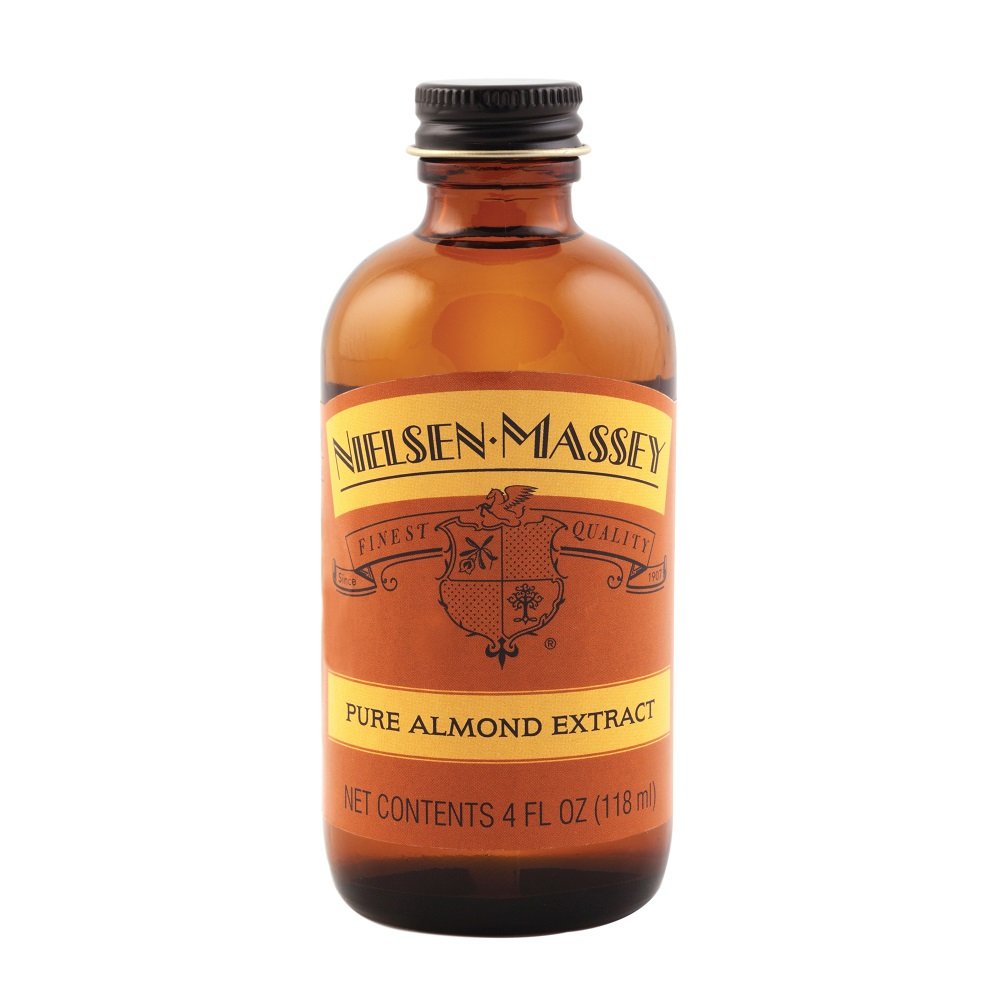
This is where the review data gets unambiguous. Among bakers who have used multiple almond extracts side by side, Nielsen-Massey generates the most enthusiastic and specific praise. Owners who maintain multiple almond extract brands describe Nielsen-Massey as the one they consistently reach for first, citing its intensity and flavor distinctiveness as the reason. That kind of comparative, multi-brand owner testimony carries real weight.
Nielsen-Massey Vanillas’ own product specification sheet for their Pure Almond Extract describes a cold-press extraction process designed to preserve volatile aromatic compounds that can degrade under heat during processing. The result, per owners, is a flavor that reads as more complex and more assertive than comparably dosed competitors — floral and clean, with a finish that doesn’t turn sharp or chemical at the doses needed to actually taste it in a finished bake.
Serious Eats, in “The Best Almond Extracts for Baking,” has consistently positioned Nielsen-Massey as a benchmark for pure flavor quality across their vanilla and almond lines. Cook’s Illustrated’s tasting archive similarly reflects that in side-by-side evaluations, premium pure extracts with concentrated aromatic profiles outperform imitation and mid-tier pure extracts most noticeably in low-heat and no-bake applications — precisely where a baker investing in flavor precision will feel the difference.
The tradeoff is price per ounce. Nielsen-Massey costs more per fluid ounce than McCormick or Rodelle, often meaningfully so. Whether that’s worth it depends entirely on your application and volume — which the FAQ section below addresses directly.

LorAnn
$22.75
In stock on Amazon
Check price on AmazonHow to Use Almond Extract Without Overdoing It
Almond extract is one of the easier flavors to overuse. The benzaldehyde compound that gives it its characteristic aroma can tip from “elegant and fragrant” to “medicinal and overpowering” quickly, especially in delicate or simple recipes. The Spruce Eats, in “What Is Almond Extract and How Do You Use It?”, recommends starting at ¼ teaspoon per standard batch — approximately 24 cookies or one 9-inch cake layer — and adjusting upward only after tasting batter or dough where safe to do so.
With a more concentrated extract like Nielsen-Massey, the starting point may be even lower — ⅛ to ¼ teaspoon — because intensity means less product delivers the same flavor signal. With a subtler extract like Rodelle, you may land closer to ½ teaspoon for the same effect.
The general principle: calibrate to your specific bottle and recipe, not to a universal rule. Concentration varies across brands and even across production batches within a brand. When in doubt, undershoot and build up.
Frequently Asked Questions
Is Nielsen-Massey almond extract really worth the higher price over McCormick?
For most bakers who are intentional about flavor, yes — with one qualifier. If you’re baking in high-heat applications where volatile aromatics burn off anyway (cookies above 375°F, dense quick breads), the gap narrows. Cook’s Illustrated’s subscriber-archive tasting notes observe that in heavily flavored baked goods, pure and imitation extracts converge. But in lower-heat or no-bake applications — buttercream, almond cream, pastry cream, no-bake cookies — owners who have compared both brands report the Nielsen-Massey difference is clearly perceptible. The cost premium is real, but for a product used in small quantities, the per-use cost difference is often a matter of cents.
How much almond extract should I use — can you use too much?
Yes, you can absolutely overdo almond extract, and it’s a more common mistake than under-dosing. Too much produces a sharp, almost chemical note that can dominate everything else in a recipe. The Spruce Eats, in “What Is Almond Extract and How Do You Use It?”, recommends a starting point of ¼ teaspoon per standard batch. With Nielsen-Massey’s reported intensity, some experienced bakers go as low as ⅛ teaspoon. Taste as you go, and remember the flavor can intensify slightly during baking as water evaporates and flavors concentrate.
What is the difference between pure and imitation almond extract in baking?
Pure almond extract derives its flavor from natural bitter almond oil or apricot kernel oil, which contains benzaldehyde as its primary aromatic compound. Imitation uses synthesized benzaldehyde directly, bypassing the botanical source. In practice, Cook’s Illustrated has noted that in heavily spiced or high-heat baked goods, the perceptible difference between pure and imitation shrinks. In delicate applications — shortbread, cream fillings, glazes — experienced bakers consistently report that pure extracts deliver more nuance and a cleaner finish. McCormick’s most widely distributed retail format is imitation; Nielsen-Massey and Rodelle are pure.
Is the Rodelle 16 oz bottle a good value for home bakers?
It depends on your bake frequency. The 16 oz format makes strong economic sense if you’re baking at volume regularly — a home baker producing large batches weekly, or a small-batch cottage kitchen operator, can work through it before shelf life becomes a concern. Almond extract shelf life is typically several years in a sealed bottle, somewhat less once opened and exposed to air. For occasional bakers, a smaller bottle of a more concentrated extract is likely more practical and avoids waste. Rodelle’s flavor is described as solid but subtle in concentration by owners — factor that into your usage estimates before committing to the large format.
Can almond extract be used in smoothies or drinks, not just baking?
Yes — almond extract is a legitimate flavoring in beverages, used in flavored lemonades, almond-forward cocktail syrups, and cold brew coffee preparations. The alcohol base present in pure extracts disperses cleanly into cold liquids. The key is starting with even less than you’d use in baking — a few drops in a 16 oz smoothie is usually sufficient. Nielsen-Massey’s intensity makes it particularly useful here, where a small amount of a high-quality extract delivers clean flavor without adding noticeable volume.
The Decision Rule
Here’s where the cost analysis and owner data converge into something actionable:
- If almond is a starring flavor in your recipe and quality matters → Nielsen-Massey. The owner data is consistent, the intensity is real, and the per-use cost is manageable at typical dosage. LorAnn — $22.75
- If you’re running a production kitchen and baking at volume → Rodelle 16 oz deserves serious consideration. Adjust your dose upward slightly to compensate for the subtler concentration profile. Nielsen — $14.99
- If you want a reliable all-around brand for a broader extract pantry → Watkins is defensible, but evaluate almond reviews specifically rather than relying on the brand’s overall extract reputation. Nielsen — $14.99
- If you’re price-sensitive and baking occasionally in standard recipes → McCormick does the job. Understand you’re likely getting imitation in the standard retail format; in most everyday applications, that’s an acceptable tradeoff. McCormick — $4.82
For most readers of this site — small-batch producers, serious home bakers, and beverage developers who care about flavor precision — Nielsen-Massey is the clear top pick. Rodelle earns its place as the volume-conscious alternative. McCormick and Watkins serve a market where accessibility and price outweigh intensity, and there’s nothing wrong with that as long as you’re buying with eyes open.