Almond extract is one of those ingredients that looks the same in every bottle — a dark amber liquid, roughly two ounces, sitting near the vanilla at your grocery store. But the similarity stops at the label. Almond extract is a flavoring made by suspending aromatic compounds in an alcohol base; those compounds are primarily responsible for the signature marzipan-like smell and taste. The key variable that almost no one talks about at the point of purchase is concentration — how much of the active flavoring compound is actually in the bottle relative to the carrier. A “pure” extract derives those compounds from natural benzaldehyde sources such as bitter almond oil or stone-fruit pits; an “imitation” extract uses synthetically produced benzaldehyde, the same molecule, made in a laboratory. That distinction matters more for your label copy and customer story than it does for flavor chemistry — but the concentration difference between brands can mean you are using four times as much product to achieve the same result. This guide breaks down what is actually in the major formats, runs the cost-per-use math, and gives you a clear decision framework organized by application and budget.
| EDITOR'S PICK[Sonoma Syrup Co Pure Almond Ext…](https://www.amazon.com/dp/B07RM3DVMY?tag=greenflower20-20) | Mid-tier[Nielsen Massey Pure Almond Extr…](https://www.amazon.com/dp/B00DUF3Y5U?tag=greenflower20-20) | Budget pick[LorAnn Oils Almond Bakery Emuls…](https://www.amazon.com/dp/B00F9WXNU8?tag=greenflower20-20) | |
|---|---|---|---|
| Product Type | Pure extract | Pure extract | Bakery emulsion |
| Size | 8 oz | 4 Fl Oz | — |
| Gluten-Free | — | — | ✓ |
| Keto-Friendly | — | — | ✓ |
| Hand Crafted | ✓ | — | — |
| Price | $27.95 | $14.99 | $7.15 |
| See on Amazon → | See on Amazon → | See on Amazon → |
Pure vs. Imitation: What the Labels Actually Mean
Let’s settle this first, because it drives a lot of purchasing anxiety that is not always warranted.
Pure almond extract gets its flavor from natural benzaldehyde — the primary aromatic compound in almonds and stone-fruit kernels. Per the U.S. Food and Drug Administration’s Code of Federal Regulations Title 21, the designation “pure” on an extract label requires that the flavoring originate from the named botanical source, with no artificial flavoring agents permitted. In practice, most commercial pure almond extracts source benzaldehyde from bitter almond oil or from the pits of apricots and peaches, which are chemically identical sources of the same compound.
Imitation almond extract uses synthetically derived benzaldehyde — manufactured via chemical synthesis rather than extracted from a plant. The molecule is the same. The Spruce Eats’ ingredient explainer on almond extract notes that trained tasters in controlled settings often cannot distinguish pure from imitation when concentration is held constant. The practical flavor difference in baked goods, where heat and sugar compete for your palate’s attention, is even smaller.
Where imitation does fall short: some producers report a slightly sharper, more one-dimensional top note, and a faster fade after baking. Across aggregated testing covered by Serious Eats, the pattern is that pure extracts show more aromatic complexity and a slightly longer-lasting flavor impression in ambient-temperature applications such as frostings, fillings, and no-bake confections. For high-heat applications — hard candy, caramel, high-temperature baking — the difference narrows significantly because benzaldehyde is volatile at elevated temperatures regardless of origin, as noted in Epicurious’s explainer on pure versus imitation extracts.
The label nuance you cannot ignore: some products marketed as “pure” are blended with imitation components to maintain consistent concentration. Always read the ingredient list, not just the front-panel claim. If you see “artificial flavor” anywhere in a product calling itself pure, that is worth flagging if your customer-facing label requires 100% natural flavoring.
Concentration: The Variable That Changes Everything
Here is where most buying decisions go wrong. Brands do not standardize concentration, and the difference is not marginal — it is significant enough to flip the cost-per-use math entirely.
The FDA does not mandate a specific concentration for pure almond extract the way it does for vanilla, which under federal regulation requires a minimum of 35% alcohol and a defined quantity of vanilla beans per gallon. For almond extract, the field is wide open. Cook’s Illustrated’s methodology notes on extract comparisons make the underlying point clearly: comparing price per bottle without normalizing for concentration “is like comparing the cost of a concentrate to a ready-to-drink beverage and concluding the concentrate is more expensive.”
The three brand tiers below are structured by concentration level and cost-per-use, and each closes with a tier marker so you can navigate directly to the format that fits your operation.
Budget Tier: Standard Grocery-Store Extract
Representative product: McCormick Pure Almond Extract (2 oz)
McCormick’s standard pure almond extract is the de facto baseline for American recipe writing. When a published recipe calls for “1 teaspoon almond extract,” it is almost always calibrated to this concentration level. The per-bottle price is low — typically in the five-to-seven-dollar range at grocery retail — and availability is universal.
The limitation is straightforward: at standard concentration, you need the full recommended volume to achieve a perceptible almond note, which means you burn through bottles quickly in any production context running more than a dozen batches per month. At that pace, the apparent savings on per-bottle price evaporate. The Spruce Eats’ almond extract ingredient coverage confirms that standard-strength extracts are well suited to occasional home baking but become inefficient at semi-professional volumes.
Best for: Occasional bakers, single-recipe testing, situations where universal recipe compatibility without any dosage adjustment is the priority.
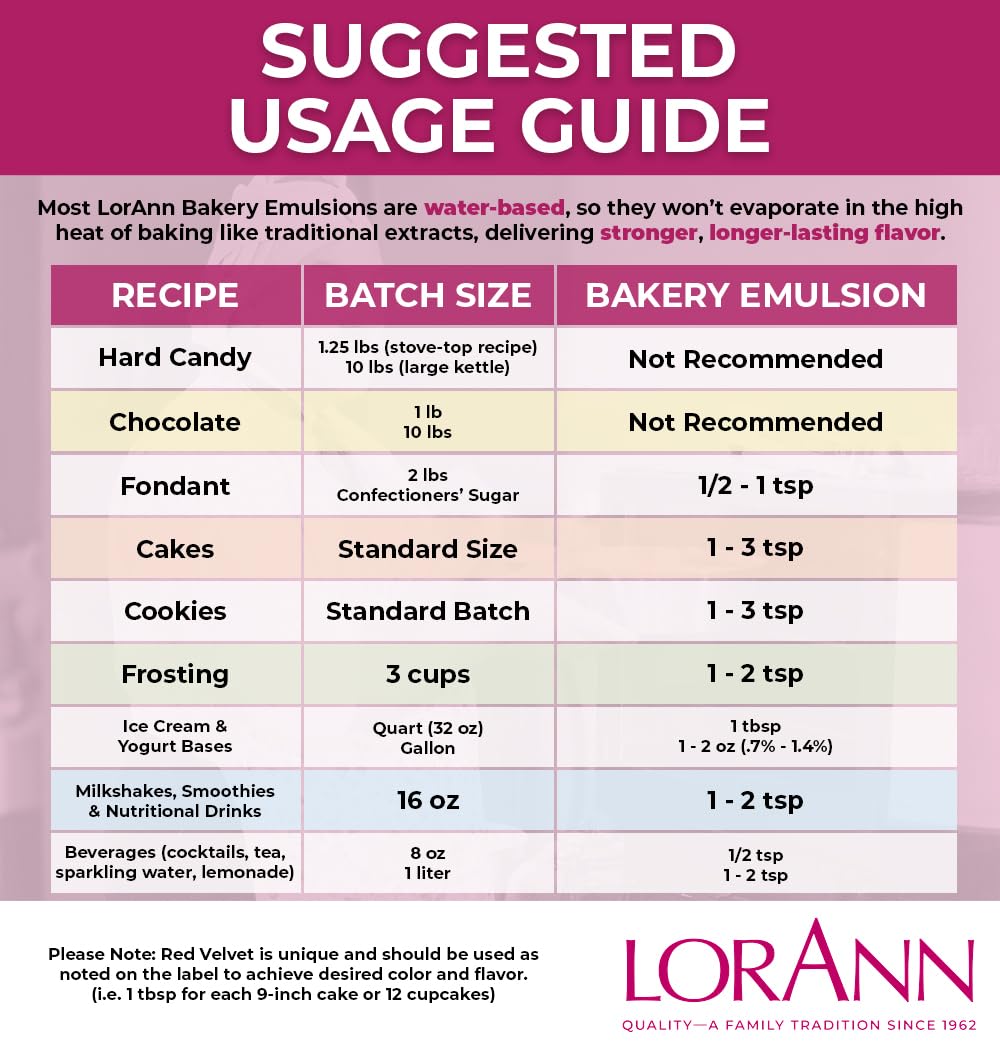
LorAnn
$7.15
In stock on Amazon
Check price on AmazonMid-Tier: High-Concentration Pure Extract
Representative product: Nielsen-Massey Pure Almond Extract
Nielsen-Massey’s pure almond extract carries a meaningfully higher concentration than grocery-store standards — usage guidance on their packaging recommends reducing volume relative to a standard-extract recipe, a reliable signal that the product is two to three times as concentrated on a per-unit-of-flavor basis. The per-bottle price runs roughly twelve to sixteen dollars for a two-ounce size, which looks expensive in isolation. Normalized for usage rate, the cost-per-use is competitive with and often lower than the budget tier for any baker running consistent volume.
Serious Eats’ aggregated extract testing notes that Nielsen-Massey extracts consistently earn recognition for aromatic depth and complexity in ambient-temperature applications — buttercreams, pastry creams, marzipan, no-bake fillings — where the full aromatic profile has the best chance of expression. Cook’s Illustrated has separately noted Nielsen-Massey as a reference-quality extract brand across its extract testing methodology.
Best for: Pastry professionals, semi-commercial bakers, macarons and cold confections, any application where pure-extract label designation is customer-facing.
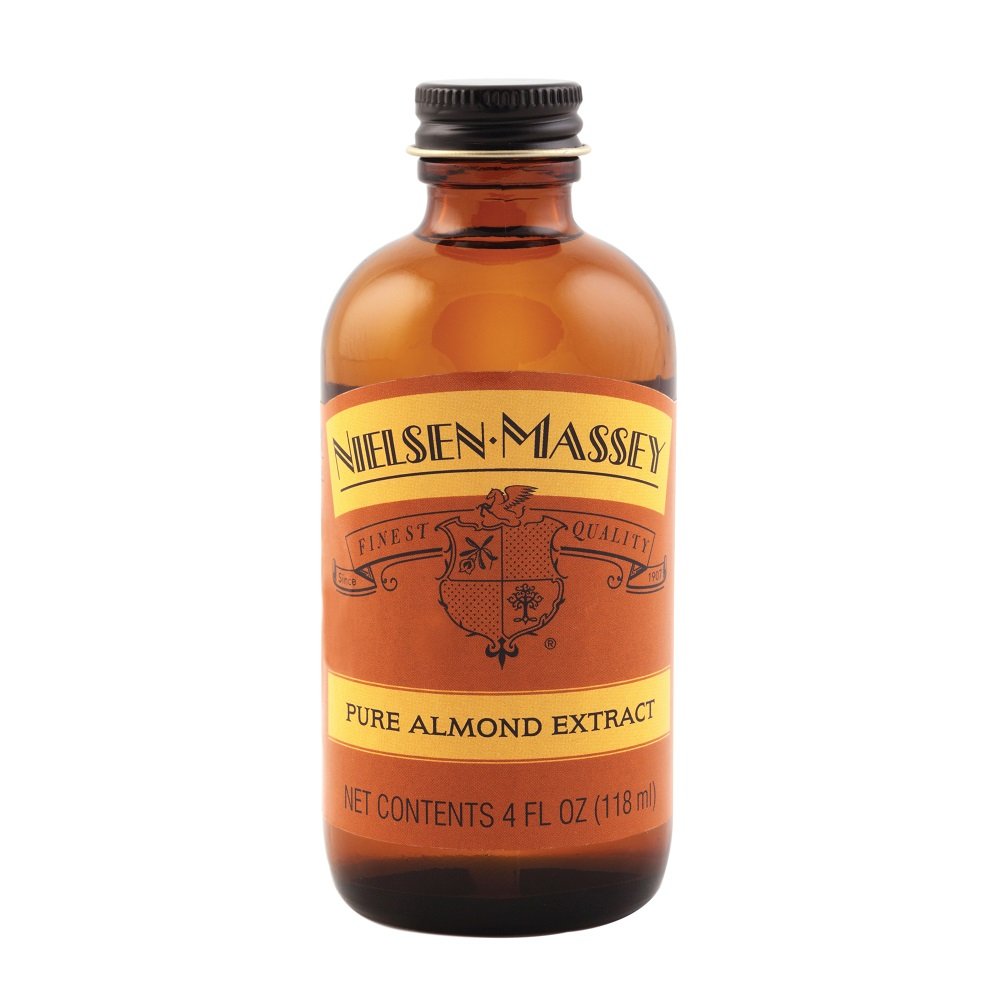
Nielsen
$14.99
In stock on Amazon
Check price on AmazonProfessional Tier: Super-Strength and Compound Formats
Representative products: LorAnn Super-Strength Almond Flavor; Amoretti Natural Almond Extract W.S.
This tier covers two distinct sub-formats that serve different application needs, but both operate at three to six times the concentration of a standard grocery extract.
LorAnn Super-Strength Almond is packaged in one-dram (approximately 3.7 mL) bottles and is designed for use at four to eight drops per batch rather than a teaspoon. That usage rate makes it exceptionally practical for small-batch production where measuring fractions of a teaspoon introduces meaningful error. The cost per dram is low in absolute terms; the cost per unit of flavor delivered is among the lowest in the category. LorAnn’s published product documentation positions the super-strength line specifically for baked goods, where benzaldehyde loss from heat is significant and a higher starting concentration compensates for oven volatility. Note that for hard candy and pulled-sugar work at temperatures above 300°F, LorAnn’s almond candy oil — a benzaldehyde-in-oil suspension with no alcohol carrier — is the appropriate product; standard extracts, including super-strength formats, lose benzaldehyde rapidly when the alcohol base flashes off at candy temperatures. That is a category switch, not a concentration adjustment.
Amoretti Natural Almond Extract W.S. (water-soluble) is a professional-grade emulsion format designed for applications where alcohol-based extracts create dispersion or flavor problems — craft beverages, cold carbonated systems, and emulsion-sensitive confections. Amoretti’s professional line is priced at the higher end of the category (roughly eighteen to thirty-five dollars for a four-ounce bottle), but the concentration and water-solubility combination make it the correct tool for beverage development and professional pastry production at scale.
Best for: High-volume baked goods (LorAnn super-strength), candy production at standard temperatures (LorAnn), craft beverages and cold confections requiring water-soluble dispersion (Amoretti W.S.), commercial pastry operations where both concentration and label quality are required.
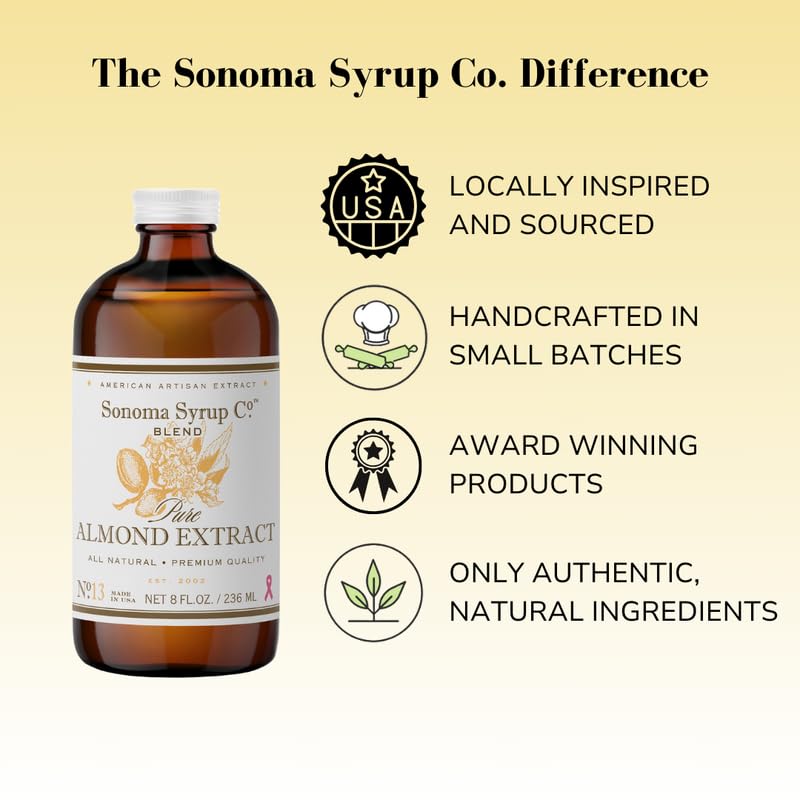
Sonoma
$27.95
In stock on Amazon
Check price on AmazonHeat Stability and Application Fit
Benzaldehyde’s volatility is the central technical variable in any almond extract purchasing decision. It begins off-gassing meaningfully in a sugar or fat matrix well before its standard boiling point, which means the oven is actively destroying flavor from the moment your product enters it.
Practical implications by application:
-
Macarons, buttercreams, and cold fillings: All extract types perform, but this is where pure extract’s aromatic complexity is most perceptible. Nielsen-Massey and Amoretti both receive consistent recognition in professional pastry contexts for depth in ambient-temperature work. The pure-versus-imitation distinction is at its most meaningful here.
-
Cake and cookie baking at standard temperatures (325–375°F): Significant benzaldehyde loss occurs in the oven regardless of extract type. A higher-concentration extract used at a reduced rate will outperform a standard-concentration extract used at the same volume, because more compound survives the heat curve. LorAnn’s super-strength format is specifically engineered for this use case.
-
Hard candy and pulled sugar (300°F and above): Standard liquid extracts — including super-strength alcohol-based formats — perform poorly here. The correct product category is flavoring oil, not extract. This is a common category error that costs flavor retention and money simultaneously.
-
Craft beverages and bitters bases: Water-soluble emulsions outperform oil-based formats because they disperse evenly without separation. Alcohol-based extracts can leave a perceptible spirit note in cold, carbonated applications. Amoretti’s W.S. line is the reference product for this application.
Epicurious’s explainer on pure versus imitation extracts makes the practical point directly: heat destroys much of the aromatic complexity that distinguishes pure from imitation, which means the cost advantage of imitation compounds further for high-heat work, while pure earns its premium in cold or ambient applications.
The Cost-Per-Use Calculation You Should Run Before Your Next Order
Here is the decision rule stated plainly, because this is where most buyers leave money on the table.
Take your current bottle cost. Divide it by the number of uses you actually get from it — not the theoretical uses based on one-teaspoon servings, but your real batch yield from one bottle. Compare that number across formats.
For most intermediate producers running fifty or more batches per quarter, the math consistently favors buying a four-ounce professional format at twenty-five to thirty-five dollars over three or four two-ounce grocery bottles at six to eight dollars each. The per-use cost drops, the storage footprint shrinks, and reorder friction decreases.
A secondary calculation worth running: if your application is high-heat baking, factor in the benzaldehyde loss curve. A standard-concentration extract that delivers, say, sixty percent of its flavor compound to the finished product is effectively more expensive than a high-concentration extract delivering the same flavor at forty percent lower dosage — even if the per-bottle price is higher.
Shelf Life and Storage: Don’t Let Concentration Work Against You
Higher-concentration extracts are not more fragile, but they do amplify storage errors. Benzaldehyde oxidizes on prolonged exposure to light and air, producing a slightly bitter, cherry-like off-note that most bakers describe as harsh or medicinal.
The Spruce Eats’ storage guidance for liquid extracts recommends cool, dark conditions and confirms that properly stored pure almond extract has an effective shelf life of three to four years — longer than most users expect, and a strong argument for buying the larger professional format even before you are at full production volume. Imitation extracts are similarly shelf-stable; synthetically produced benzaldehyde is manufactured to a tighter purity specification and is somewhat less susceptible to the trace contaminants that can accelerate oxidation in natural-source extracts.
Practical rules: dark glass or opaque packaging, away from heat sources, cap replaced tightly after each use. Dram-sized LorAnn formats have the advantage of minimal headspace after opening — less air contact, slower oxidation. If you have moved to a four-ounce professional bottle, consider portioning a working supply into smaller amber glass dropper bottles for daily bench use, keeping the bulk sealed in storage.
Almond extract is a small line item that makes an outsized flavor difference — which is exactly why concentration transparency matters more than brand loyalty or the pure-versus-imitation debate. Run the math on your current usage pattern, match the format to your application’s heat profile, and buy the size that keeps your cost-per-use honest. The upgrade almost always pays for itself within a quarter.