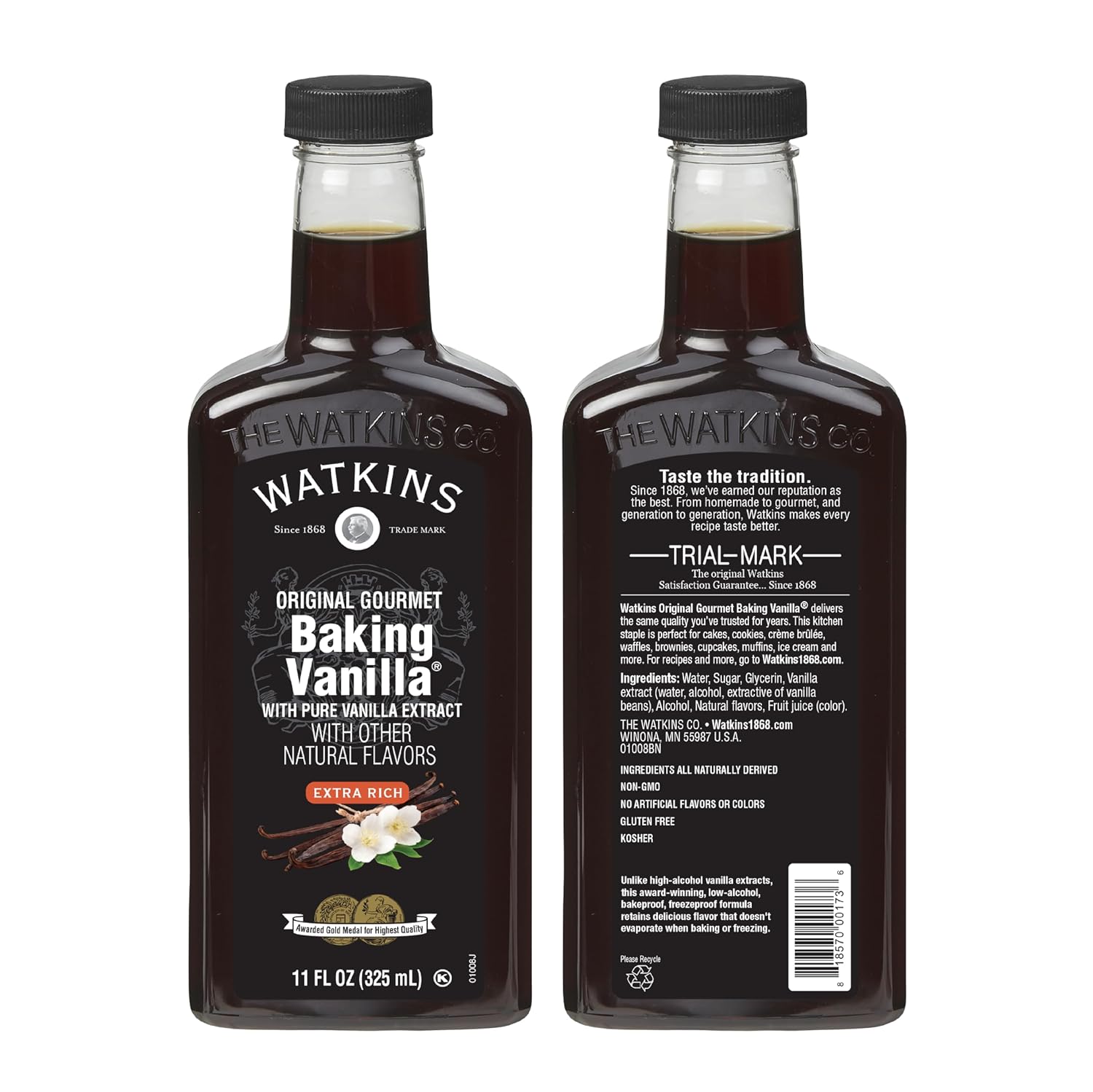
If you’ve ever handed a baker a gorgeous three-tier white cake and watched the client tilt her head and say “it’s a little… ivory, isn’t it?” — you already understand why this conversation matters. Vanilla extract, the dark amber liquid most of us grew up adding by the teaspoon, does two things at once: it flavors and it tints. For most applications that’s fine. But when “white” genuinely means white — wedding buttercream, bright sugar cookie icing, meringue, white velvet cake — that amber pigment becomes a real problem. Clear vanilla extract (technically a clear imitation vanilla flavoring) removes the color entirely by swapping out the naturally pigmented vanilla bean components for synthesized vanillin, a colorless compound that produces the characteristic vanilla aroma. This article breaks down the tradeoffs so you can make a confident call: when to use clear, when to stay with dark pure, how to dose each, and which products practitioners are actually reaching for in 2026.
| EDITOR'S PICKDanncy Vanilla Clear 33.8 fl oz… | Mid-tierWatkins All Natural Original Go… | Budget pickMcCormick Culinary Imitation Va… | |
|---|---|---|---|
| Type | Clear flavoring | Pure vanilla extract | Imitation vanilla |
| Volume | — | 11 fl oz | 16 fl oz |
| Pack count | 2 | 1 | 1 |
| Clear color | ✓ | — | — |
| Real vanilla | — | ✓ | ✗ |
| Price | $22.89 | $12.35 | $7.44 |
| See on Amazon → | See on Amazon → | See on Amazon → |
Clear vs. Dark: What’s Actually Different Inside the Bottle
Let’s get the chemistry out of the way plainly, because it shapes every decision downstream.
Pure vanilla extract — the dark stuff, regulated by the FDA under 21 CFR Part 169 — is made by macerating real vanilla beans in an alcohol-water solution. The beans deposit hundreds of flavor compounds plus pigments (primarily vanillin glucoside and related phenolics) that turn the liquid deep brown. Those same pigments tint anything you fold it into.
Clear imitation vanilla skips the beans entirely. The predominant flavor compound, vanillin, is synthesized (most commonly from lignin or guaiacol) and dissolved in a carrier — often propylene glycol or water — without the pigmented co-extractives. The result is colorless and shelf-stable, but it carries a flavor profile that’s flatter: strong on the characteristic “vanilla” note, light on the complex floral and fruity undertones you get from a full-spectrum extract.
Serious Eats’ deep-dive on vanilla (authored by Stella Parks) notes that in baked applications — anything heated above roughly 250°F — the flavor differences between pure and imitation narrow considerably, because heat degrades many of the more volatile aromatic compounds that distinguish a Madagascar single-origin from a synthesized vanillin. That finding is practically useful: it means you don’t necessarily have to choose aesthetics over flavor in a baked white cake — you can use clear in the batter and suffer very little flavor penalty.
In uncooked applications — raw buttercream, no-bake cheesecakes, cold-process frostings — the gap widens. Pure vanilla’s full aromatic signature survives intact, and so does its color. Clear imitation delivers a thinner but still pleasant vanilla note, and it stays invisible in your frosting. This is the core tradeoff.
By the Numbers
| Application | Heat | Color impact of pure vanilla | Flavor gap vs. pure | Recommendation |
|---|---|---|---|---|
| White wedding buttercream (uncooked) | None | High — visibly creams toward ivory | Noticeable in a side-by-side | Use clear |
| White velvet / white cake batter | 325–375°F | Moderate | Minimal after baking | Clear acceptable; pure fine if ivory is OK |
| Sugar cookie dough (baked) | 325–375°F | Low | Minimal | Either |
| Raw sugar cookie royal icing | None | High | Noticeable | Use clear |
| Meringue / Swiss meringue buttercream | 160°F pasteurization + whipping | Moderate | Moderate | Clear if color-critical |
The Dosing Problem Nobody Warns You About
Clear vanilla is not a 1:1 swap in every context. Here’s what catches practitioners off guard.
Most clear imitation vanillas are formulated at a higher vanillin concentration than a standard pure extract — partly to compensate for the missing aromatic complexity, partly because the industrial customers who typically buy in volume need to hit a flavor threshold. Watkins clear vanilla, for example, is an imitation flavoring with a noticeably assertive front note.
Reviewers of Danncy Clear Vanilla — a popular option among cookie decorators — have flagged something worth taking seriously: at high doses, Danncy can read as almost cinnamon-like or woody, particularly in delicate royal icing and sugar cookie applications where there’s nothing else to hide behind. This is not a defect per se; it’s a dosing signal. Owner-reported observations (not lab-verified claims) suggest that 1 teaspoon per standard batch works cleanly, while pushing to 1½–2 teaspoons in a small-volume, uncooked icing tips the flavor profile in an unexpected direction. If you’re building a house recipe, start low and proof the flavor before scaling.
The general practitioner rule: cut your standard pure vanilla dosage by 10–20% when swapping to a concentrated clear imitation, then taste before committing. Cook’s Illustrated’s vanilla extract testing corroborates the general principle that imitation vanilla’s vanillin concentration can run ahead of pure’s in perceptible flavor intensity for some applications.
The “alcohol taste” complaint is a separate but related issue. Multiple buyers across clear vanilla SKUs specifically cite grocery-store vanilla tasting harsh or boozy in uncooked frostings — a legitimate concern, since standard pure vanilla is 35% alcohol by FDA definition and that alcohol doesn’t bake off in no-heat applications. Clear imitation vanillas formulated with a propylene glycol or glycerin base have no meaningful alcohol content, which is a real functional advantage for raw buttercream. The Spruce Eats’ overview of clear vanilla extract confirms that the reduced-alcohol carrier is one of its practical draws specifically for uncooked preparations. This is worth disclosing to clients if provenance matters to them.
Which Products Practitioners Are Actually Using
Watkins Clear Imitation Vanilla has a long track record in professional cake decorating circles. One professional decorator’s account (reported across multiple review aggregations) is worth quoting in spirit: she uses it specifically when a bride orders “white-white” icing, because even a half-teaspoon of dark pure vanilla will push American buttercream toward cream rather than white. Owner reviews consistently describe Watkins as clean-tasting with a balanced vanillin note — not as aggressively concentrated as some competitors, which makes it forgiving to dose.
McCormick Culinary Clear Imitation Vanilla (32 oz) is the high-volume format that appeals to a specific practitioner: the baker producing hundreds of units per week. Reviewers of the 32 oz SKU are almost uniformly volume-focused — one account describes baking cookies, muffins, and breads for an extended family network at a pace where a small bottle becomes a logistics problem. The cost-per-ounce math on the 32 oz format is meaningfully better than 8 oz retail, and McCormick Culinary’s commercial-grade formulation is consistent batch-to-batch in a way that matters when you’re standardizing house recipes. If your weekly vanilla consumption exceeds 4 oz, the large format math starts to make sense.
Danncy Clear Vanilla lands here as a value-oriented option with a stronger concentration profile. It performs well in baked applications and standard buttercream, but — as the owner-reported dosing notes above indicate — it rewards careful calibration in delicate uncooked work. For a high-volume cookie decorator comfortable doing a quick taste-test before each batch, it’s a defensible workhorse. For someone who wants to set a recipe and forget it, the more moderate concentration of Watkins or McCormick Culinary may be less risky.
A note on using pure vanilla in white cakes: if the application is a baked white cake (not buttercream), Nielsen-Massey Pure Vanilla Extract remains the flavor benchmark, and many professionals use it in the batter because the amber tint bakes off to a negligible contribution in a white cake formula with good egg white technique. The choice to use pure vs. clear in the cake layer itself is partly aesthetic preference — a true white crumb requires clear, but an off-white crumb is not a failure, and the flavor reward of Nielsen-Massey is genuine. Save the clear for the frosting where color is most visible.
Shelf Life, Storage, and Batch Consistency
Clear imitation vanilla is generally more shelf-stable than pure extract for one simple reason: there are no real botanical compounds to degrade or precipitate. A propylene glycol-based clear vanilla stored in a cool, dark pantry will hold consistent flavor for 3–5 years under normal conditions. Pure vanilla extract, if stored properly (away from heat and light, tightly sealed), also has a long shelf life — the FDA does not require an expiration date for products above 35% alcohol — but its flavor complexity can shift over time, particularly if repeatedly opened.
For a bakery environment producing color-critical work year-round, the stability of a clear imitation is an operational advantage: you can buy the 32 oz format without worrying about the tail of the bottle tasting different from the front. Batch-to-batch consistency is one of the stronger arguments for clear imitation in standardized commercial applications, alongside color control and cost.
Frequently Asked Questions
Will clear vanilla affect the color of white buttercream frosting? No — that’s the entire point. Clear imitation vanilla contributes no pigment to your frosting, so American buttercream, Swiss meringue, and royal icing made with it stay true white rather than pulling toward ivory or cream. Owner reports across multiple products confirm this consistently, though results can vary based on your butter’s natural color and other ingredients.
Does imitation clear vanilla taste noticeably different from pure in baked goods? In baked applications — cakes, cookies, muffins — the difference is smaller than most people expect. Serious Eats’ analysis of pure vs. imitation vanilla notes that heat degradation levels the playing field considerably. In side-by-side baked tests, most tasters cannot reliably distinguish them. In raw applications (uncooked buttercream, no-bake fillings), the gap is real: pure vanilla is more complex, while clear imitation leads with a cleaner, simpler vanillin note. Neither is wrong — they’re different tools.
What happens if you use too much clear vanilla — does it taste odd? Yes, at high doses. Owner-reported observations on products like Danncy Clear note that excess clear vanilla in delicate applications (thin royal icing, simple syrup-based preparations) can produce a woody or slightly medicinal taste sometimes described as cinnamon-adjacent. The practical fix: start at or below your standard pure vanilla dosage, taste, and adjust upward cautiously. Clear imitation is not always weaker than pure — some formulations run at higher vanillin concentration.
Is the large 32 oz bottle of McCormick Culinary worth it for home bakers? Honestly, for most home bakers: no. A 32 oz bottle is a multi-year supply at typical home baking volumes, and even a shelf-stable clear imitation benefits from consistent storage conditions. The format makes sense once your weekly vanilla usage is meaningful — think weekly large batches, holiday baking for crowds, or a small cottage operation. If you’re baking for a household, an 8 oz bottle is a better fit.
Can clear vanilla be used in uncooked frostings without an alcohol taste? Yes, and this is one of its clearest practical advantages. Most clear imitation vanillas use a propylene glycol or glycerin carrier rather than the alcohol base required for pure extract. In raw buttercream and royal icing, alcohol doesn’t evaporate — it stays in the frosting and can read as harsh or sharp, especially to sensitive palates. Switching to a PG-based clear imitation eliminates that issue entirely. This is a genuine functional win for uncooked applications, not just a marketing claim — The Spruce Eats’ overview of clear vanilla specifically identifies this as a key use-case advantage.
The Decision Rule
If your client ordered white, use clear vanilla in the frosting — full stop. The color control isn’t worth gambling on.
If you’re working on the cake layer and color in the crumb matters, use clear there too. If you can tolerate a faint ivory crumb (most clients cannot tell), pure vanilla in the batter gives you better flavor depth with no penalty you’ll taste after baking.
If volume is the driving purchase variable (you’re baking in quantity weekly), the 32 oz McCormick Culinary format earns its place in your supply chain. If you’re doing precision small-batch decorating work, Watkins’ moderate concentration is more forgiving. If you want a value option and you’re willing to dial in your dosage carefully, Danncy is worth a trial batch — just taste before you scale.
And if someone asks you why you’re not using “real” vanilla in the wedding cake frosting: now you have the full answer.