If you’ve ever pulled a blueberry muffin out of the oven only to find that bright, jammy berry flavor you added had somehow evaporated into thin air, you’ve already discovered the central problem with fruit flavorings and heat. Unlike vanilla — which is remarkably stable at baking temperatures — most fruit flavors are built from delicate aromatic compounds that simply cook off when exposed to 350°F for 20 minutes. The solution isn’t to add more flavoring; it’s to choose the right format of flavoring in the first place.
Fruit flavorings come in three main forms: extracts (flavor compounds dissolved in alcohol), emulsions (flavor suspended in a water-based, often gum-stabilized carrier that locks in aroma better under heat), and super-strength concentrates (highly concentrated flavor oils, used in tiny amounts). Each behaves differently in the oven. This guide breaks down how OliveNation’s berry sets and LorAnn’s flavor line compare across those formats — with honest tradeoffs on heat stability, cost, and when each format is actually worth your money.
Why Format Matters More Than Brand for Baked Goods
The format question is the one most intermediate bakers skip past, and it’s where most disappointing results originate. Here’s the underlying science in plain terms.
Alcohol-based extracts — the classic format — work beautifully in no-heat applications: frosting, mousse, cold-process drinks, ice cream bases. In the oven, the alcohol carrier volatilizes early in baking, and it takes a significant portion of the lighter aromatic compounds with it. Fine Cooking’s overview of baking extracts notes this directly: alcohol extracts are best suited for applications where heat is minimal or applied briefly.
Emulsions solve this problem by suspending flavor in a water-and-gum base (typically propylene glycol and a stabilizer like xanthan or gum arabic). Because there’s no alcohol to flash off, the flavor compounds stay in suspension longer, releasing more gradually through the bake. Cook’s Illustrated, in their flavor retention analysis, found that emulsion-format flavorings consistently outperformed alcohol extracts in finished-product intensity for full-bake applications like layer cakes and muffins.
Super-strength concentrates — LorAnn’s signature category — are flavor oils at very high concentration, typically 3–4x the strength of a standard extract. They’re oil-soluble, which helps them bind into fat-rich batters (think shortbread, pound cake, cookie dough). They don’t have the alcohol problem, but oil-soluble formats can occasionally separate in very lean, high-water batters. The dosage math is also less forgiving: the standard usage rate is roughly ¼ teaspoon per pound of batter, compared to 1 teaspoon or more for a standard extract.
By the Numbers
| Format | Typical Use Rate | Relative Heat Stability | Best Application |
|---|---|---|---|
| Alcohol extract (standard) | 1–2 tsp per recipe | Low–moderate | Frostings, no-bake, quick breads |
| Water-based emulsion | 1–1½ tsp per recipe | High | Full-bake cakes, muffins, cookies |
| Super-strength concentrate (oil) | ¼ tsp per recipe | Moderate–high | Fat-rich doughs, candy, hard applications |
Usage rate guidance sourced from LorAnn Oils manufacturer documentation and OliveNation catalog usage notes.
OliveNation Berry Sets: What You’re Actually Buying
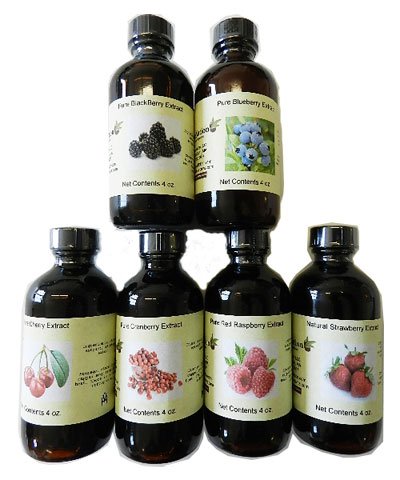
OliveNation’s berry extract sets — typically bundled as 3–6 flavors including strawberry, raspberry, blueberry, and blackberry — are one of the most commonly referenced starting points for home bakers stepping up from grocery-store vanilla. The format across most of their berry line is alcohol-based extract, with a handful of emulsion options available separately.
At the $20–$40 price point for a multi-flavor set (depending on bottle size and whether you’re buying the 4 oz or 8 oz tier), the value proposition is real: you get a working palette of fruit flavors without committing $15–$25 per individual specialty bottle. For cold applications and light bakes, reviewers across the specialty food community consistently describe OliveNation berry extracts as clean and true-to-fruit, particularly the raspberry and blackberry expressions.
The honest limitation: for full-bake applications above 325°F, most alcohol-format berry extracts in this line will fade significantly. This isn’t a knock on OliveNation specifically — it’s a format constraint. Blueberry and strawberry are the most volatile. Raspberry holds a bit better, likely due to the slightly more complex aromatic profile that includes some compounds with higher boiling points.
When OliveNation berry sets make sense:
- Buttercreams, glazes, and cream cheese frostings
- Cheesecake filling (baked at lower temp, shorter time)
- Ice cream bases and no-churn applications
- Mousse and panna cotta
- Layering flavor post-bake by brushing on a simple syrup spiked with extract
When to look elsewhere: If your primary application is a full-bake muffin, a 350°F cake, or a cookie with a 12-minute bake time, you’ll consistently lose 30–50% of the perceived fruit intensity to heat volatilization based on standard food science benchmarks cited in IFT’s flavor encapsulation technical brief.
LorAnn Super-Strength Concentrates: The Precision Tool
LorAnn’s super-strength line is the format that earns the most practitioner attention, and for good reason. These are flavor oils — highly concentrated, alcohol-free, oil-soluble — and LorAnn’s product spec sheets confirm the standard dosing guidance: approximately ¼ to ½ teaspoon replaces 1 teaspoon of a standard extract, adjusting for the target application.
For baking, the oil-soluble format gives you a meaningful advantage in fat-rich recipes. Butter cakes, shortbread, brownies, and enriched doughs all have enough lipid content to carry the oil-soluble flavor compounds evenly through the matrix. The result, across aggregated baker reviews on specialty food forums, is a more consistent flavor distribution and noticeably better heat retention compared to alcohol extracts at equivalent intensity.
At $4–$8 per 1-dram bottle (roughly 3.7 mL), LorAnn concentrates look expensive per bottle but are among the best cost-per-use values in the fruit flavoring category once you account for the concentration multiple. A single 1-dram bottle, used at ¼ tsp per batch, gets you approximately 14–16 batches. At the $6 price point, that’s under $0.45 per use — competitive with any format on a per-batch basis.
The tradeoff to name explicitly: Super-strength concentrates are less forgiving for novice dosing. Overuse — even slightly — can push fruit flavors into an artificial, “candy-flavored” register that experienced bakers describe as “lozengy” or “medicinal.” The fix is simple: start at the lower end of the usage range (¼ tsp), taste the batter or dough if safe to do so, and adjust incrementally. But if you’re handing this to someone without a calibrated palate, the margin for error is narrower than with extracts.
LorAnn also produces a separate bakery emulsion line (strawberry, blueberry, raspberry among others) at a slightly larger format and higher price point — typically $6–$10 for a 4 oz bottle. These emulsions are the format to choose when you want heat stability and the ability to use more typical recipe volumes without overthinking measurement precision. Serious Eats’ vanilla extract methodology notes that emulsions “hold flavor more reliably in baked applications” — a conclusion that extends to the fruit emulsion category on the same mechanistic grounds.
Making the Call: A Decision Framework
Here’s where a lot of intermediate bakers stall — they understand both products but aren’t sure which one to stock. The honest answer is that these formats aren’t competitors; they’re complements for different slots in your production workflow. But if you’re building a focused pantry and need to prioritize, the decision rule is straightforward.
If your primary application is baked goods at or above 325°F for more than 15 minutes: LorAnn’s super-strength concentrates (for fat-rich doughs and enriched batters) or LorAnn’s bakery emulsions (for lean batters and layer cakes) should be your default. The heat stability data, manufacturer documentation, and baker consensus all point in the same direction. OliveNation’s alcohol extracts will underperform here regardless of dosage.
If you’re building a versatile flavor palette for mixed applications — some baking, some frostings, some beverages or no-bake work: A hybrid approach makes practical sense. OliveNation berry sets at the 4 oz tier cover your cold-application and low-heat work economically. One or two LorAnn super-strength bottles (start with strawberry and raspberry, which are the most universally useful) cover your high-heat baking slots. Total outlay for a functional dual-format berry pantry runs roughly $30–$55 depending on the OliveNation bundle size you choose.
If you’re producing at small-batch commercial scale — cottage bakery, farmers market operation, small-run confections — the cost-per-use math tilts hard toward LorAnn concentrates or toward professional-grade emulsions from Amoretti or OliveNation’s commercial tier. At 50+ batches per month, the dosage efficiency of a super-strength concentrate pays for itself within two or three reorder cycles compared to standard-extract volumes.
One More Variable: Shelf Life Under Working Conditions
Both formats are stable at room temperature for 2–4 years when sealed, but the practical shelf life under working conditions — bottles opened regularly, stored near the oven — differs. Alcohol extracts are naturally self-preserving and very forgiving of minor temperature variation. Oil-based concentrates can oxidize if stored in direct light or heat and should be kept in a cool, dark location; LorAnn’s documentation recommends storage below 75°F for best longevity. Emulsions fall in between: stable and self-preserving, but the emulsification structure can degrade if repeatedly exposed to temperature cycling above 80°F.
For a production kitchen where the flavor shelf is near the oven, emulsions in amber glass bottles are the most practical long-term choice. Concentrates in metal-lidded bottles fare better than those in standard plastic dropper bottles if your workspace runs warm.
The bottom line: fruit flavor in baked goods is a solvable problem, but the solution starts at the format decision, not the brand decision. OliveNation berry sets are genuinely good for what they’re designed to do — cold and low-heat applications with a generous flavor palette at an accessible price. LorAnn’s super-strength concentrates and emulsions are precision tools for the oven. Know which problem you’re solving before you add to cart, and the results will follow.