If you’ve ever baked a batch of sugar cookies only to wonder where all that lovely vanilla flavor went, you’ve already discovered the core problem this article is about. Most home bakers start with extracts — concentrated flavor solutions where aromatic compounds are suspended in alcohol (usually ethanol). Alcohol is an excellent solvent for pulling flavor out of vanilla beans, citrus zest, or almond skins. The problem is that alcohol also evaporates quickly at oven temperatures, and it can take a significant portion of your flavor with it. LorAnn Oils, a Michigan-based flavoring company well known to home bakers and small-batch professionals alike, makes a second product category called bakery emulsions — water-based suspensions where flavor compounds are physically encased in tiny droplets stabilized by an emulsifier rather than dissolved in alcohol. That single formulation difference changes how the flavor behaves when heat gets involved. This guide breaks down exactly when each format wins, shows you the cost-per-use math, and ends with a clear decision framework so you can spec the right product before your next production run.
The Chemistry Difference That Actually Matters in the Oven
Let’s be precise about what’s happening in each bottle, because the mechanism explains every practical tradeoff.
In a standard extract, flavor compounds — vanillin, benzaldehyde, linalool, and dozens of others depending on the source — are dissolved directly into an alcohol-water base. Per FDA 21 CFR Part 169, pure extract products must run at a minimum of 35% alcohol by volume to qualify for the “pure extract” label designation. When that hits a 350°F oven, alcohol’s boiling point of roughly 173°F means it begins volatilizing well before your bake is done. Some flavor volatiles escape with it. You’re not losing all of the flavor — many aromatic compounds bind to sugars and fats and stay put — but you are losing a meaningful fraction of the high-note brightness, particularly in long bake times.
In a water-based emulsion, the flavor molecules are encapsulated in microscopic droplets stabilized by an emulsifier, typically a food-grade gum or lecithin derivative. Water’s boiling point is 212°F, and at most baking temperatures the emulsion matrix doesn’t volatilize as aggressively as an alcohol carrier. More importantly, the encapsulation itself creates a physical barrier that slows flavor release and protects volatile aromatics during the thermal exposure window. The Institute of Food Technologists, in their published overview of flavor delivery in baked applications, describes this encapsulation mechanism as one of the primary tools for improving flavor retention in high-heat and extended-bake scenarios — the same principle used in commercial bakery flavor systems at much higher price points.
LorAnn’s own product documentation for their Bakery Emulsion line explicitly notes that emulsions are “specifically designed for baked goods” and deliver flavor that holds up through baking, citing improved flavor persistence compared to standard extracts. Fine Cooking’s overview of flavor formats in baking similarly describes the general advantage of emulsified delivery systems in oven applications as a function of delayed volatilization rather than any single brand formulation.
One more structural point: emulsions are water-soluble but not alcohol-based, which makes them integrate more smoothly into water-heavy batters like pound cakes, white cakes, and enriched breads, where an alcohol carrier can occasionally create uneven distribution at higher usage rates.
Head-to-Head: Where Each Format Wins and Loses
This is the comparison you’re here for. The three application categories below cover the vast majority of real baking decisions. Each subsection ends with a clear tier call so you can spec quickly.
Baked Goods with Long or High-Heat Exposure
Cookies, cakes, quick breads, muffins — anything spending 20–45 minutes above 300°F. This is emulsions’ strongest argument. Stella Parks, writing for Serious Eats on vanilla’s role in baking, reinforces the point that baked applications benefit from flavor delivery systems that don’t rely solely on alcohol volatilization for distribution. When vanilla or almond is meant to be a primary flavor note rather than background support, the difference between a well-retained emulsion flavor and a partially baked-off extract becomes perceptible in the finished product.
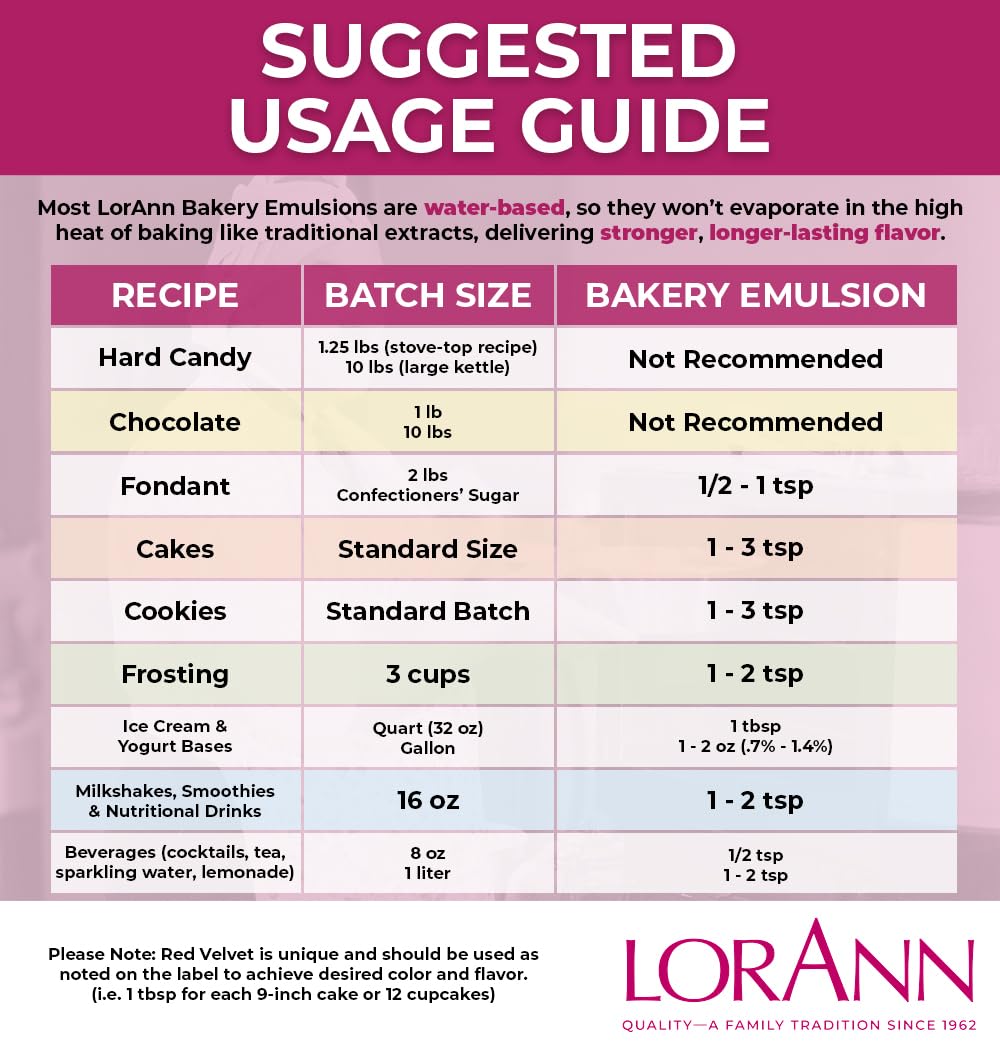
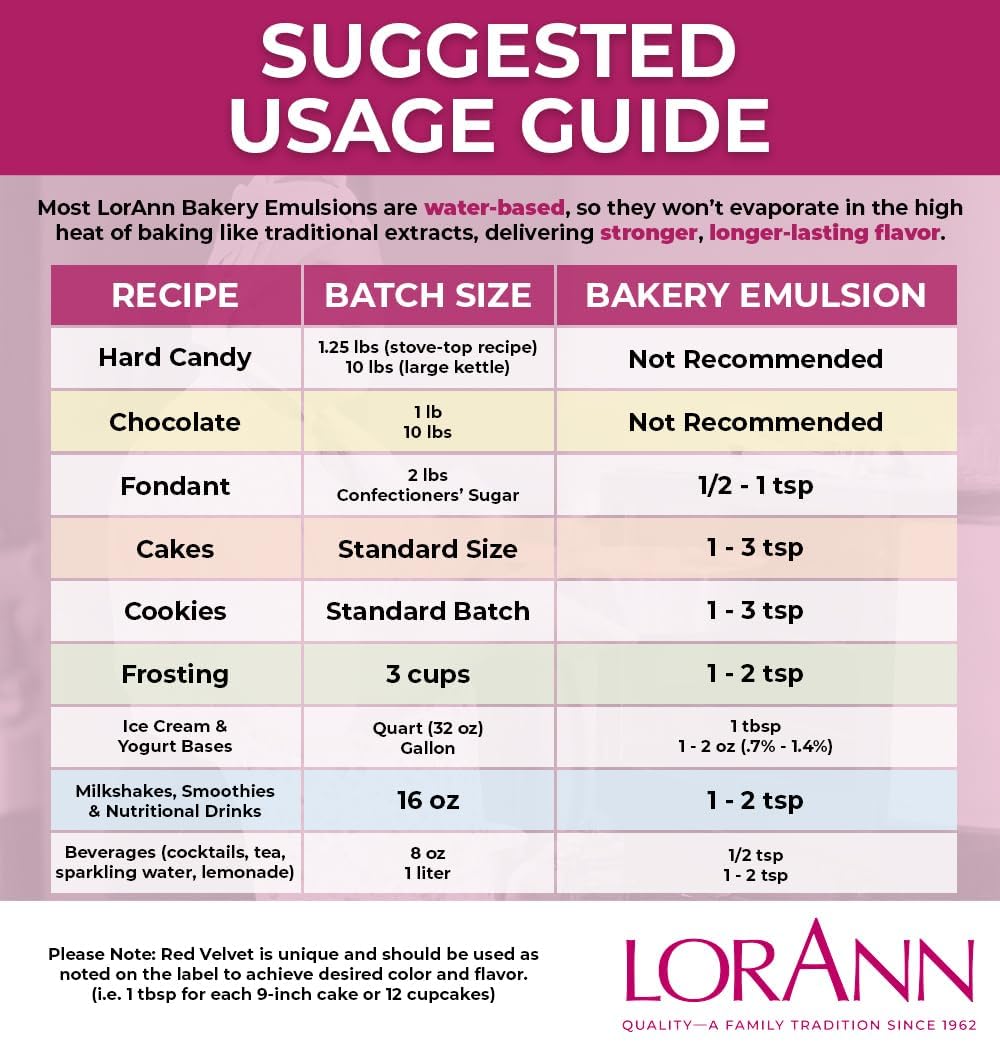
LorAnn vanilla, almond, butter vanilla, and lemon bakery emulsions are purpose-built for exactly this scenario. The 1:1 substitution ratio (documented in LorAnn’s usage guidelines) makes the switch operationally simple — no formula recalculation required.
LorAnn
$7.64
In stock on Amazon
Check price on AmazonFrostings, Glazes, and No-Bake Fillings
Here the comparison flips. In a buttercream or royal icing that never sees heat, the alcohol carrier in an extract isn’t a liability — it’s actually a mild asset, helping flavor distribute quickly and evenly into fat-heavy bases. No-bake cheesecake fillings, ganache, and cold-process fudge all work well with extracts. The sharp brightness of a well-made pure extract reads as more “authentic” and complex in cold applications because the volatile top notes are fully intact — nothing has been baked off.
Emulsions work fine in frostings, but some practitioners note that water-based emulsions can very occasionally affect texture in high-fat, low-moisture systems like a stiff decorator’s buttercream. It’s rarely a problem at standard usage rates (1 tsp per batch), but it’s worth knowing before scaling up.
Cook’s Illustrated’s coverage of vanilla extract versus paste formats notes that the full aromatic complexity of high-quality vanilla is best preserved and perceived in unheated or minimally heated applications — an observation that applies directly to the extract-versus-emulsion comparison in cold formats.
 product image](/images/external/d10f1672fd50.jpg)
Nielsen-Massey
In stock on Amazon
Check price on AmazonHigh-Sugar Candy and Moderate-Temperature Confections
This is where both formats get stress-tested. Hard candy production runs at temperatures of 300°F or higher — well above both the alcohol boiling point and the standard baking window. For hard candy specifically, LorAnn is best known for their super-strength flavoring oils, which are oil-soluble and rated for extreme temperatures. Neither an extract nor an emulsion is the right call for hard-crack candy work; that’s the oils’ territory.
But if you’re choosing between an extract and an emulsion for a confection that doesn’t hit full hard-crack temperatures — a soft caramel or a fudge cooked to 235°F — the emulsion’s better thermal retention is the more defensible specification. Fine Cooking’s guidance on baking flavor formats notes that heat-sensitive aromatic compounds benefit from any delivery mechanism that delays their volatilization window, which is precisely the structural advantage emulsions carry at moderate candy temperatures.
Lorann
$9.99
In stock on Amazon
Check price on AmazonBy the Numbers
Understanding cost-per-use is important for any practitioner buying at volume. The table below uses prevailing 2026 retail pricing across major specialty food retailers; batch cost is calculated at the standard 1 tsp usage rate.
| Format | Typical Retail (1 oz) | Usage Rate | Approx. Cost Per Batch |
|---|---|---|---|
| LorAnn Bakery Emulsion (vanilla) | ~$4–$7 | 1 tsp per recipe | ~$0.25–$0.45 |
| LorAnn Pure Vanilla Extract | ~$6–$9 | 1 tsp per recipe | ~$0.40–$0.60 |
| Nielsen-Massey Pure Vanilla Extract | ~$18–$30 (4 oz) | 1 tsp per recipe | ~$0.55–$0.90 |
Retail estimates based on prevailing 2026 pricing. Scale cost per batch proportionally for production runs.
The cost-per-use math consistently favors LorAnn emulsions over premium extracts for baked applications — not because premium extracts aren’t excellent, but because a meaningful portion of what you’re paying for in a high-quality pure extract (delicate aromatic top notes) gets reduced by oven heat anyway. For baked applications, emulsions frequently deliver more functional flavor value per dollar. For cold applications where those top notes survive intact, the premium extract’s complexity is more fully realized and worth the price premium.
Concentration Ratios and Substitution Math
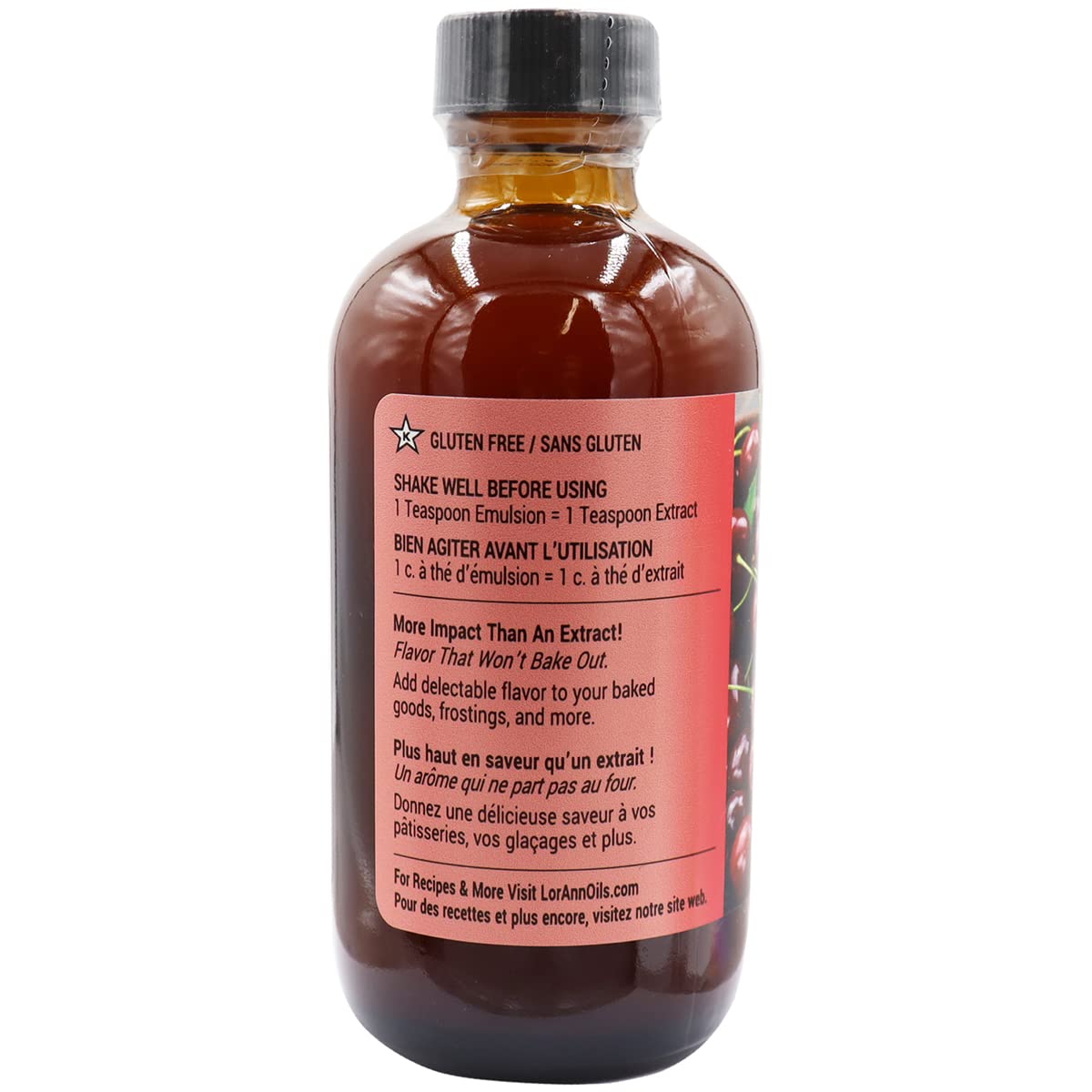
LorAnn bakery emulsions are designed as a direct 1:1 substitution for standard extracts in most baking applications. If a recipe calls for 1 teaspoon of vanilla extract, you use 1 teaspoon of vanilla bakery emulsion. LorAnn’s usage documentation confirms this ratio explicitly, making the swap operationally low-friction for any recipe that already specifies an extract.
Where this gets more nuanced is substituting emulsions for LorAnn super-strength flavoring oils — concentrated oil-soluble flavorings typically used at ¼ to ½ teaspoon per recipe. Emulsions are not the same concentration level as super-strength oils. Moving between those two formats requires a ratio adjustment, typically 3:1 to 4:1 emulsion to oil, and you need to account for the water content the emulsion introduces into your formula. For batters sensitive to moisture balance — shortbread, macaron shells, thin tuiles — this water contribution matters.
For practitioners sourcing at volume: LorAnn emulsions are available in 4 oz, 8 oz, and larger trade sizes depending on the flavor, which meaningfully reduces per-unit cost for small-batch production. The 4 oz size starts making economic sense at roughly two to three baking sessions per week.
Shelf Life and Storage: One Real Difference Worth Knowing
Both formats store reasonably well, but they are not identical on shelf life.
Alcohol-based extracts have a natural preservative advantage from the ethanol content. Per FDA guidance on alcohol-preserved food products, a properly sealed pure vanilla extract stored in a cool, dark location is essentially shelf-stable indefinitely, with flavor quality holding well for two or more years under typical pantry conditions. This makes extracts forgiving for intermittent home use.
Water-based emulsions don’t carry that same preservative buffer. LorAnn’s product documentation recommends using emulsions within approximately three years of purchase and storing them cool and away from direct light. Opened emulsions are best used within 12–18 months for optimal flavor strength, though they remain safe beyond that window. For a cottage baker working through a 4 oz bottle over several months, this is a non-issue. For a higher-volume operator buying 8 oz or larger sizes, it’s a first-in-first-out inventory consideration worth building into your par stock planning.
The practical takeaway: don’t let emulsions sit on the shelf for four years the way you might a well-sealed extract. Size your purchase to your actual throughput.
The Decision Framework: If X, Then Y
You’ve read the comparison. Here is the clear rule set for choosing:
If your application involves heat above 250°F and bake time over 15 minutes → specify LorAnn Bakery Emulsion. This is the scenario it was engineered for. The thermal retention advantage is real and manufacturer-documented, and the 1:1 substitution makes implementation simple.
If your application is cold — frosting, no-bake filling, glaze, cold beverage → extract is at least equally good and arguably better for applications where you want bright, high-note aromatic complexity. A LorAnn or Nielsen-Massey pure extract makes full sense here, and the premium price of a high-quality extract is more fully justified because those volatile top notes survive to the palate intact.
If you’re running a small-batch production operation and baking is your primary format → the cost-per-use math makes emulsions the defensible default for baked SKUs. Reserve premium extracts for products where a cold application or a “pure vanilla extract” label claim matters to your customer.
If your temperature exceeds 300°F (hard candy, caramel cooked to firm ball or above) → neither extract nor emulsion is your primary tool. LorAnn’s super-strength flavoring oils are the appropriate format for those thermal conditions.
If you’re substituting and aren’t sure → start at 1:1 for the emulsion-to-extract swap. Adjust up by ¼ tsp increments if you want more forward flavor expression in dense batters like pound cake or banana bread, where flavor tends to mute during extended baking.
The bottom line is straightforward: these two formats aren’t competing for the same job. Extracts are general-purpose and excellent in cold or short-heat applications. Emulsions are purpose-built for the oven. Matching the format to the thermal environment is the single highest-leverage decision you can make — and at LorAnn’s price point, there is no meaningful cost barrier to stocking both and using each where it wins.