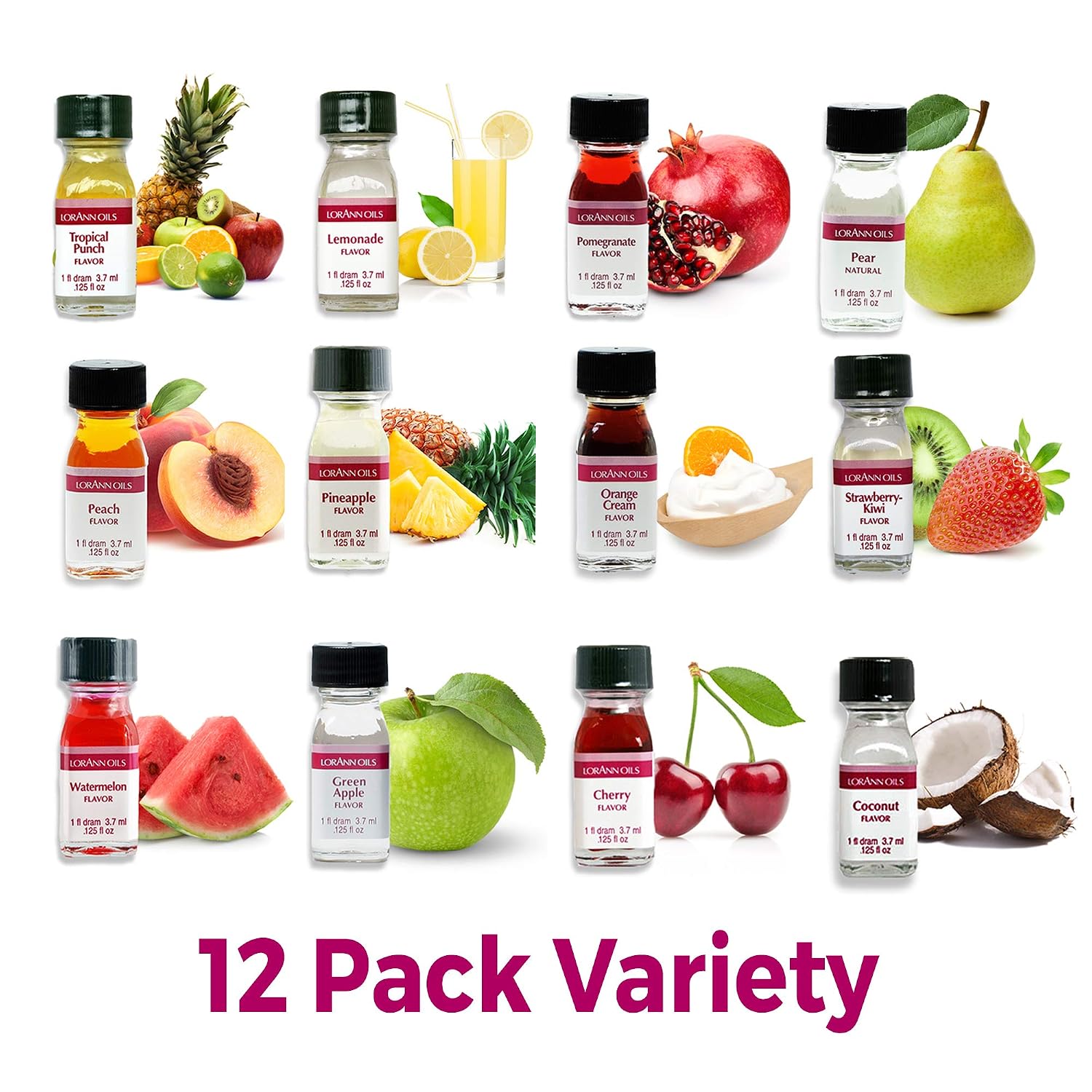
If you’ve ever landed on LorAnn’s product page and felt mildly overwhelmed by the sheer number of flavor options, you’re not alone. LorAnn makes what are called “super strength” flavor concentrates — highly potent, food-grade flavoring oils (meaning they’re based in oil rather than water or alcohol) that require only a fraction of a teaspoon to flavor an entire batch of hard candy, a layer cake, or a homemade soda. Because they’re so concentrated, a single 1-dram (3.7 ml) bottle goes much further than a standard grocery-store extract. The trade-off is that buying them one at a time adds up quickly when you’re trying to stock a versatile pantry. That’s exactly the problem LorAnn’s variety packs are designed to solve — but the packs themselves aren’t all equivalent, and choosing the wrong one means either redundant flavors you’ll never use or critical gaps you’ll notice mid-batch.
This guide breaks down the main variety pack options, maps each to its strongest application (candy, baking, or beverages), shows you the math on cost-per-bottle, and ends with a clear decision framework so you know which bundle fits your current workflow.
| EDITOR'S PICK[LorAnn SS flavors 12 pack of 1…](https://www.amazon.com/dp/B08R432YWX?tag=greenflower20-20) | Mid-tierLorann Oils 1 Dram Children’s F… | Budget pick[LorAnn SS 4 pack Citrus Flavor…](https://www.amazon.com/dp/B00WKJ2VJM?tag=greenflower20-20) | |
|---|---|---|---|
| Bottle count | 12 | 10 | 4 |
| Customizable | ✓ | ✗ | ✗ |
| Theme | Custom | Children's Favorites | Citrus Mix |
| Price | $22.75 | $17.14 | $8.99 |
| See on Amazon → | See on Amazon → | See on Amazon → |
What Makes LorAnn “Super Strength” Different From Standard Extracts
Before comparing packs, it helps to understand what you’re buying. LorAnn’s super strength oils are typically formulated at three to four times the potency of standard water-based extracts, according to LorAnn Oils’ published usage documentation. The manufacturer’s standard guidance puts usage at approximately one-quarter to one-half teaspoon per pound of sugar for most hard candy applications — compared to one to two teaspoons for a typical grocery-store extract in a comparable batch.
This concentration difference has direct consequences for three things practitioners care about:
Heat stability. Oil-based concentrates perform significantly better in high-heat applications like hard candy and pulled sugar (where you’re working at 300°F / 149°C or above). Water-based extracts flash off their aroma compounds at those temperatures. Fine Cooking’s coverage of candy flavoring consistently points to oil-based formats as the standard recommendation when working above 250°F. For baking applications under 375°F, the gap narrows, and for cold-process beverages, it’s largely irrelevant — which is why application matching matters when choosing a pack.
Solubility. Oil-based flavors don’t disperse naturally in water-dominant recipes without an emulsifier or a carrier like propylene glycol. In a simple syrup or carbonated beverage base, a straight oil concentrate will float and won’t distribute evenly. The Spruce Eats’ guide to baking concentrates notes this as one of the more common beginner errors — using oil-format flavors in aqueous applications without a dispersion step.
Dosing precision. Because the flavors are so strong, a small measurement error (adding a full teaspoon instead of a quarter teaspoon) can produce an unpleasant medicinal or chemical note. Reviewers across aggregated feedback consistently flag over-dosing as the leading source of negative results with this product line — not the quality of the flavor itself.
Breaking Down the Main Variety Pack Formats
LorAnn’s variety pack lineup, as of mid-2026, clusters around four primary configurations. Pricing below reflects standard retail; bundle price-per-bottle varies with retailer.
The Classic Candy Pack (typically 12–18 flavors, ~$18–$28)
This is LorAnn’s longest-running bundle format and the one most clearly optimized for hard candy, lollipop, and pulled sugar work. Flavor profiles lean toward fruit-forward and mint-forward selections: cherry, watermelon, cinnamon, peppermint, spearmint, lemon, lime, orange, and similar. Per LorAnn’s own product documentation, all flavors in this configuration are formulated to be heat-stable at hard crack temperatures (300°F+), making them the correct choice for sugar work without needing to verify individual SKUs.
Where it underperforms: Baked goods and beverages. The fruit and candy profiles are intense and linear — great for hard candy where you want a clean single-flavor hit, but lacking the complexity that works well in a vanilla cake, a spice cookie, or a craft soda. There’s also typically no vanilla, no warm spice (like cardamom or clove), and no botanical flavors in these packs.
By the numbers:
- Typical pack: 12 bottles / ~$24 retail = ~$2.00 per bottle
- Equivalent single-bottle retail: ~$4.50–$5.50 each
- Savings realized: roughly 40–55% vs. buying individually
The Baking & Dessert Pack (typically 10–14 flavors, ~$20–$32)
This format introduces vanilla, almond, butter, lemon, and sometimes more unusual inclusions like coconut, maple, or cream cheese. These are formulated primarily for oven-temperature applications (under 400°F) rather than candy temperatures. Serious Eats’ coverage of baking extracts makes the point that oil-based formats in this range offer better flavor retention through a full bake cycle compared to alcohol-based extracts, because the oil carrier doesn’t volatilize as quickly.
Where it underperforms: It’s not a candy pack. Several flavors in baking configurations (butter, vanilla, almond) are not rated for hard crack temperatures, and using them in sugar work above 275°F risks burning off the top notes and leaving a flat or bitter undertone. The FDA’s GRAS flavor documentation is useful background here — it covers heat degradation thresholds for common flavor compounds, and many almond and vanilla flavor compounds degrade meaningfully above 280°F.
Where it genuinely excels: Cottage bakers building an extract pantry for the first time get a lot of mileage from this format. The flavor profiles translate cleanly across layer cakes, quick breads, frostings, and no-bake applications.
The Beverage & Soda Flavoring Pack (typically 10–16 flavors, ~$22–$35)
This is the configuration that causes the most confusion among practitioners, because LorAnn doesn’t always label it with beverage-specific terminology. The tell is in the flavor list: you’ll see cola, root beer, grape, blue raspberry, tropical punch, and similar profiles — flavors that map to carbonated soda and beverage applications rather than baking or candy.
Critical caveat, and this is the one most practitioners miss: oil-format concentrates require an emulsification or dispersion step in water-based beverages. Without it, the flavor will not distribute evenly. LorAnn’s published usage guidelines for beverage applications recommend either using their water-soluble flavor line (a separate product format) or incorporating an emulsifier like lecithin when working oil-based flavors into liquid bases. Craft soda developers sourcing through beverage ingredient suppliers generally find water-soluble formats more practical for this application — the oil-based variety pack is better suited for flavoring candy, hard tack, or baked goods with these profiles than for direct liquid application.
The “Sampler” or Holiday Variety Pack (8–12 flavors, ~$15–$22)
These seasonally rotated packs (pumpkin spice, peppermint bark, eggnog, and similar) are best treated as supplemental rather than foundational. They’re often the most cost-effective way to acquire one or two specialty seasonal flavors you’d otherwise buy at full single-bottle price, but they shouldn’t anchor a working pantry.
The Cross-Application Problem: Can Any Single Pack Do All Three?
Here’s the honest answer: no single stock variety pack currently covers candy, baking, and beverages with full depth. The application requirements pull in different directions — heat stability thresholds are incompatible between candy-grade and baking-grade formulations, and the beverage application introduces a solubility format issue that a single pack can’t resolve.
That said, the Baking & Dessert pack plus the Classic Candy pack together come closest to a full working set for practitioners doing two of the three applications. At combined retail around $45–$55, you’d have roughly 22–30 bottles covering heat-stable candy flavors, oven-stable baking flavors, and sufficient overlap for cold-process applications like frostings, dips, and no-bake desserts. The cost-per-use math on that combination still beats buying 25+ individual SKUs by a meaningful margin.
For practitioners also doing beverages, the practical move is to buy the two-pack combination described above, then source LorAnn’s water-soluble flavor line separately for liquid applications rather than trying to force oil-format concentrates into that use case.
Shelf Life and Storage: What Affects Your Cost-Per-Use Math
A common miscalculation when evaluating variety pack value is ignoring shelf life. LorAnn’s published product documentation lists an unopened shelf life of three to four years for most super strength flavors stored in cool, dark conditions, and recommends using opened bottles within two years for optimal potency. Aromatics-rich flavors (citrus especially) degrade faster once opened.
If you’re a hobbyist running two to three candy or baking projects per month, a 12-bottle variety pack will likely see full utilization before degradation becomes a factor. If you’re a high-volume small-batch producer cycling through multiple batches per week, shelf life is rarely the binding constraint — throughput is.
The practical implication: don’t let variety pack value seduce you into buying more SKUs than your current project cadence can consume in 18 months. A $24 pack that sits mostly unused for three years is less economical than three targeted single-bottle purchases.
Decision Framework: If X, Then Y
If you’re primarily a candy maker or sugar artist working at hard crack temperatures: buy the Classic Candy Pack. It’s the only format where every bottle is verified heat-stable at the temperatures you’re working at. Supplement with individual baking-grade SKUs for fillings and frostings.
If you’re primarily a home or cottage baker running layer cakes, quick breads, and cold-process frostings: the Baking & Dessert pack is your foundation. Don’t rely on it for hard candy without checking individual SKU heat ratings first.
If you do both candy and baking at meaningful volume: buy the Classic Candy Pack and the Baking & Dessert Pack together. The overlap is minimal (most candy-grade fruit flavors don’t duplicate the baking-grade vanilla/spice profiles), and you’ll have a working pantry of 22–30 bottles for around $45–$55 — still under the cost of buying 15 individual bottles separately.
If you’re a craft beverage developer working with carbonated or cold-mixed formulations: the oil-based variety packs are not your primary format. Treat them as supplemental for candy garnishes or baked components in your product line, and source LorAnn’s water-soluble line or a beverage-grade emulsion format (Amoretti’s artisan syrup concentrates are a commonly cited alternative in this tier) for your liquid applications.
If you’re brand new to flavoring concentrates and want to test the format before committing to application-specific packs: the Holiday Sampler pack is the lowest-risk entry point at $15–$22. You’ll lose some breadth, but you’ll get a clear read on dosing sensitivity and flavor performance across a few applications before spending $50+ on a two-pack combination.
The variety pack format works best when you match it to your dominant application first, treat it as a pantry foundation rather than a complete toolkit, and resist the instinct to over-stock flavors you’ll use less than twice a year.