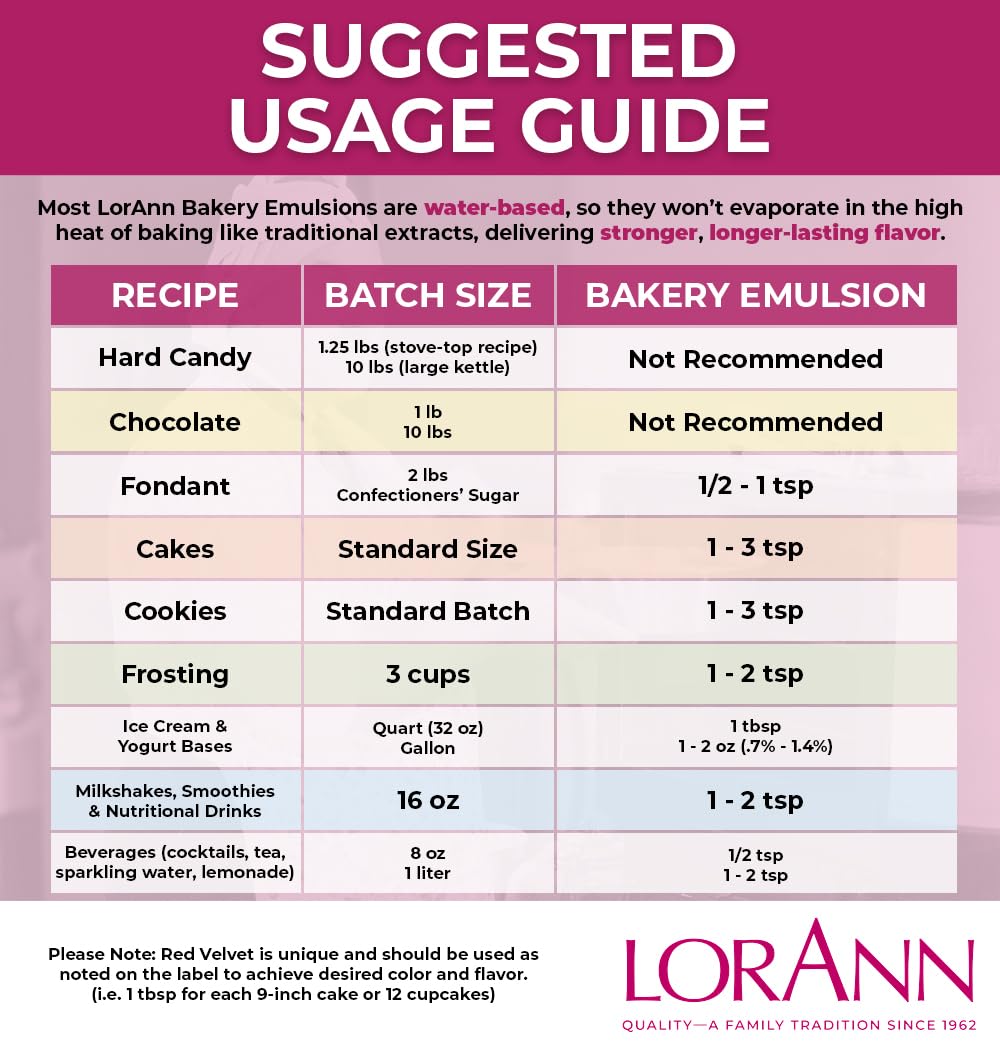
If you’ve ever added vanilla extract to a batch of whipped cream and noticed the flavor fade by the time it hit the table, you’ve already encountered the core problem that bakery emulsions solve. A bakery emulsion is a water-based flavoring — the flavor compounds are suspended in water rather than dissolved in alcohol like a traditional extract — which means two things: the flavor stays stable under heat instead of baking off, and it plays nicer in water-based recipes like icings, syrups, and drinks. LorAnn Oils, a Michigan-based flavoring company with decades in the professional candy and baking supply space, makes a line of these emulsions that have quietly built a loyal following well outside the bakery. Buyers are blending them into protein shakes, stirring them into fruit salads, and building craft drink syrups out of them — and documenting the results in enough detail that there’s now a real decision framework worth walking through. This guide pulls that pattern together so you can figure out whether an emulsion fits your current project and, if so, which one to reach for first.
What Makes LorAnn Emulsions Different from Their Super-Strength Oils
This distinction matters practically, not just technically. LorAnn’s super-strength oils are concentrated flavor compounds suspended in a carrier oil — usually a food-grade lipid base. They’re powerful (the company’s published usage guidance cites roughly ¼ teaspoon per pound of chocolate or candy coating), they’re heat-stable in the sense that the oil carrier doesn’t flash off, and they’re excellent in fat-based applications: chocolate, hard candy, and any recipe where you’re already working in a lipid environment.
The bakery emulsions are a different animal. The water base makes them:
- Naturally miscible with aqueous systems — they disperse cleanly into batters, frostings, syrups, and beverages without requiring an emulsifier on your end
- Alcohol-free by formulation, which matters for certain dietary applications and also means there’s no alcohol vapor to carry volatile aromatics out of the oven
- Better suited to long-bake applications — Fine Cooking’s overview of flavor emulsions notes that water-based carriers help lock aromatic compounds into the food matrix rather than letting them volatilize with steam
The trade-off is behavior in pure-fat environments. If you’re tempering chocolate or making a hard candy pull, the oils are still the right call. But for anything that contains water — which is most baking, most frosting, most beverages, most syrups — the emulsions are the more predictable tool.
By the numbers:
- Typical usage rate (LorAnn published guidance): 1 tsp per recipe batch / 1–2 tsp per pound of batter
- Orange emulsion equivalent to fresh zest: reviewers report 1 tsp replacing the zest of one medium orange
- Cherry/lemon emulsion batch dosing: 1 tsp per full biscotti batch per buyer documentation
- Peanut butter emulsion: multiple buyers report needing 2–3× standard rate to reach target intensity
The Off-Label Uses Buyers Are Actually Documenting
This is where the aggregated review pattern gets genuinely useful. LorAnn markets these emulsions for baking, but a measurable share of their buyers have found applications the label never mentions, and they’re specific enough to be actionable.
Beverage and Protein Drink Applications
One of the more detailed buyer accounts involves the cookie butter emulsion blended with pumpkin seed protein powder and agave in a protein drink. The buyer describes the result as “freaking DELICIOUS” — which is worth taking seriously not as a subjective endorsement but as a signal that the emulsion’s water-miscibility solves a real problem protein drink builders face: most flavor concentrates either separate in cold liquid or leave a slick film.
That same property — stable dispersion in water — is why buyers are reaching for emulsions rather than oils when building drink applications. A few patterns worth noting:
- Dilution rate for single-serve beverages: buyers who’ve documented this consistently land at 1–3 drops per 8–12 oz drink when adding directly, or ¼–½ tsp when building into a simple syrup (1:1 sugar/water) that then doses at 1 tablespoon per serving
- Cold stability: across aggregated reviews, buyers report clean dispersion in cold liquids with no oiling or beading — consistent with the water-base formulation
- Warm beverages: the emulsion’s heat-stability advantage, documented by the Spruce Eats in their frosting application guide, transfers here — buyers report no flavor fade in warm drinks
The Orange Emulsion in Non-Baking Food Applications
This one is worth calling out specifically because the claim is bold: a buyer documents using the orange emulsion in a fruit salad and states they cannot distinguish the result from dishes made with fresh orange zest or dried zest. If that holds up to even moderate scrutiny, it argues for a different use category entirely — not baking, not beverage, but finishing and seasoning.
Serious Eats’ coverage of flavor emulsions and extracts notes that the quality ceiling on citrus emulsions depends heavily on whether the manufacturer uses cold-pressed peel oil as the flavor source versus synthetic citral compounds. LorAnn’s published formulation notes reference natural orange oil as the base, which aligns with what buyers are tasting. For recipe developers doing citrus-forward work in Q2 when fresh citrus pricing spikes, this is a cost-and-consistency argument worth modeling out.
Butter Vanilla in Shelf-Stable Frosting
Buyers praise the butter vanilla emulsion specifically for frosting that doesn’t need refrigeration — the professional and semi-pro baker concern this addresses is real. Standard vanilla extracts in American buttercream can create minor alcohol bloom in unrefrigerated conditions, and the butter notes in extract form tend to fade. Buyers consistently report that the butter vanilla emulsion holds its profile in room-temperature buttercream for the shelf life of the baked good, which aligns with the documented behavior of water-based emulsions in high-sugar matrices per LorAnn’s own published usage guidance.
Where the Pattern Breaks: The Peanut Butter Emulsion Problem
Honest coverage requires naming this one directly. The peanut butter emulsion shows a divergent pattern in buyer feedback: multiple reviewers document needing two to three times the standard dosing rate to reach the flavor intensity they’d expect from other emulsions in the line. One buyer describes adding what they consider an excessive amount before the peanut character registers clearly.
This isn’t necessarily a product defect — peanut flavor compounds are notoriously difficult to emulsify with high fidelity because the dominant aromatics (pyrazines, aldehydes) are both volatile and fat-soluble, which puts them at odds with the water-based carrier. Flavor Apprentice’s published documentation on their peanut butter concentrate notes similar concentration challenges. For buyers specifically seeking peanut forward flavor in a finished product, the honest decision frame is: plan to use more, test early, and consider whether an oil-based alternative is better suited if the application is fat-rich anyway.
Concentration and Cost-Per-Use Math
One of the structural advantages of LorAnn emulsions at the 4 oz bottle size is that the per-use cost remains low even when you’re running them in non-standard applications.
Working from buyer-documented usage rates:
| Application | Emulsion Used | Documented Rate | Estimated Uses per 4 oz Bottle |
|---|---|---|---|
| Protein drink (direct add) | Cookie Butter | 2 drops per 12 oz | ~600+ drinks |
| Fruit salad finishing | Orange | ½ tsp per 4-serving bowl | ~48 batches |
| Biscotti batch | Cherry/Lemon | 1 tsp per batch | ~24 batches |
| Shelf-stable buttercream | Butter Vanilla | 1–2 tsp per lb of frosting | 12–24 lb frosting |
At the $4–$8 retail range for a 4 oz bottle, the cost-per-use math is nearly always favorable compared to fresh flavor sources — the orange emulsion case against fresh zest being the clearest example given mid-2026 fresh citrus pricing.
Frequently Asked Questions
Can LorAnn bakery emulsions be used directly in drinks or do they need to be mixed into a syrup first?
Both approaches work, and buyer documentation supports either depending on your target. Direct addition — 1 to 3 drops per 8–12 oz — works in cold and warm liquids because the water base disperses without requiring a syrup matrix. Syrup pre-mixing (¼ to ½ tsp emulsion per cup of simple syrup) gives you more dosing control across a batch of drinks and is the better call for anything you’re making at volume or serving to others where consistency matters.
How many drops should I use in a single drink?
Start at 1–2 drops and taste before adding more. The emulsions are not super-strength concentrates — they’re calibrated for batch baking — so they’re more forgiving than LorAnn’s oils, but the flavor can still build past what you want. Buyers who’ve documented single-serve use consistently land between 1 and 4 drops depending on the flavor (citrus emulsions register faster than vanilla or butter notes at equivalent volume).
Will emulsions separate or leave an oily film in cold drinks?
Based on the water-base formulation and consistent buyer accounts across aggregated reviews, separation and oiling are not reported issues with LorAnn bakery emulsions in cold liquids — which is explicitly the opposite experience buyers report with the super-strength oils. The water carrier is the reason. If you see any cloudiness, that’s the emulsion dispersing normally, not separation.
What is the difference between LorAnn emulsions and LorAnn super-strength oils for beverages?
The short version: oils disperse in fat, emulsions disperse in water. For any beverage with significant water content, the emulsion is the cleaner tool — it won’t bead, film, or concentrate at the surface. The super-strength oils are better suited to fat-rich applications (chocolate drinks with whole-cream bases, fat-washed spirits) where the oil carrier has a hospitable environment. Fine Cooking’s emulsion overview covers this distinction clearly.
Can I use the butter vanilla emulsion in no-bake or unrefrigerated frosting?
Yes, and this is one of the more consistently documented use cases across buyer accounts. The water-based carrier actually performs better than alcohol-based extracts in high-sugar, unrefrigerated environments because there’s no volatile alcohol component to carry off. Buyers specifically cite shelf-stable buttercream as the reason they switched to the butter vanilla emulsion from extract, and the Spruce Eats’ frosting guide corroborates that emulsions are generally the better choice in any frosting that needs to hold at room temperature.
The Decision Frame
If your project involves any water-based matrix — drink syrups, protein shakes, frostings, custards, fruit applications, or batch beverages — LorAnn emulsions are a rational first reach before you move up the concentration ladder to Flavorah or Amoretti. The dosing math is forgiving, the cost-per-use is low, and the off-label applications buyers have documented are specific enough to trust.
If X, then Y:
- If you’re building a single-serve beverage application: start with the orange or butter vanilla emulsion at 1–2 drops direct, adjust up from there — both have strong track records in water-based drinks
- If you need peanut butter flavor specifically: plan for higher usage rates and test at 2× the standard dose from the start; consider whether an oil-based concentrate might serve a fat-rich application better
- If shelf-stable frosting is the priority: the butter vanilla emulsion is the specific tool buyers reach for and document working
- If you’re replacing fresh citrus in a recipe: the orange emulsion’s buyer-documented comparison to fresh zest makes it worth a trial run before investing in more expensive botanical citrus oils
The emulsions are not the highest-concentration option in the LorAnn line, and they’re not trying to be. What they are is a consistently reliable, water-friendly flavoring that travels further than its bakery label suggests — and buyers have done enough real-world work to show exactly where it goes.