If you’ve ever stood in the baking aisle staring at a wall of tiny brown bottles wondering whether the expensive one is actually worth it, you’re not alone. Vanilla extract — the liquid flavoring made by soaking vanilla beans (the seed pods of the Vanilla planifolia orchid) in alcohol — is one of the most-used ingredients in home and professional baking. Nielsen-Massey is a family-owned company that has been processing vanilla since 1907, and their name comes up constantly among serious bakers. But they don’t just make one product. Their lineup includes a pure vanilla extract, a vanilla bean paste (a thick, syrup-like blend that includes real bean specks), a Madagascar Bourbon-specific extract, and an almond extract that has developed its own devoted following. Each format behaves differently in the kitchen. This article breaks down when to use each one, how they compare on concentration and cost-per-use, and where the tradeoffs actually land — so you can make the call with confidence rather than guesswork.
| EDITOR'S PICKNielsen-Massey Madagascar Bourb… | Mid-tierNielsen-Massey Pure Vanilla Ext… | Budget pickNielsen-Massey Pure Vanilla Bea… | |
|---|---|---|---|
| Volume | 4 fl oz | 4 fl oz | 4 oz |
| Form | Extract | Extract | Bean paste |
| Vanilla type | Madagascar Bourbon | — | — |
| Bottle vs jar | Bottle | Bottle | Jar |
| Pack count | 1 | 1 | — |
| Price | $18.97 | $17.45 | |
| See on Amazon → | See on Amazon → | See on Amazon → |
How the Nielsen-Massey Lineup Is Organized
Before diving into format-by-format comparisons, it helps to understand the three distinct tiers within the Nielsen-Massey portfolio: their entry point for everyday baking (the multi-origin pure extract), their single-origin prestige extract (Madagascar Bourbon), and their specialty formats (vanilla bean paste and almond extract). Each tier serves a different purpose, and buying the wrong one for your application is the most common mistake practitioners make.
The Multi-Origin Pure Extract: Everyday Workhorse
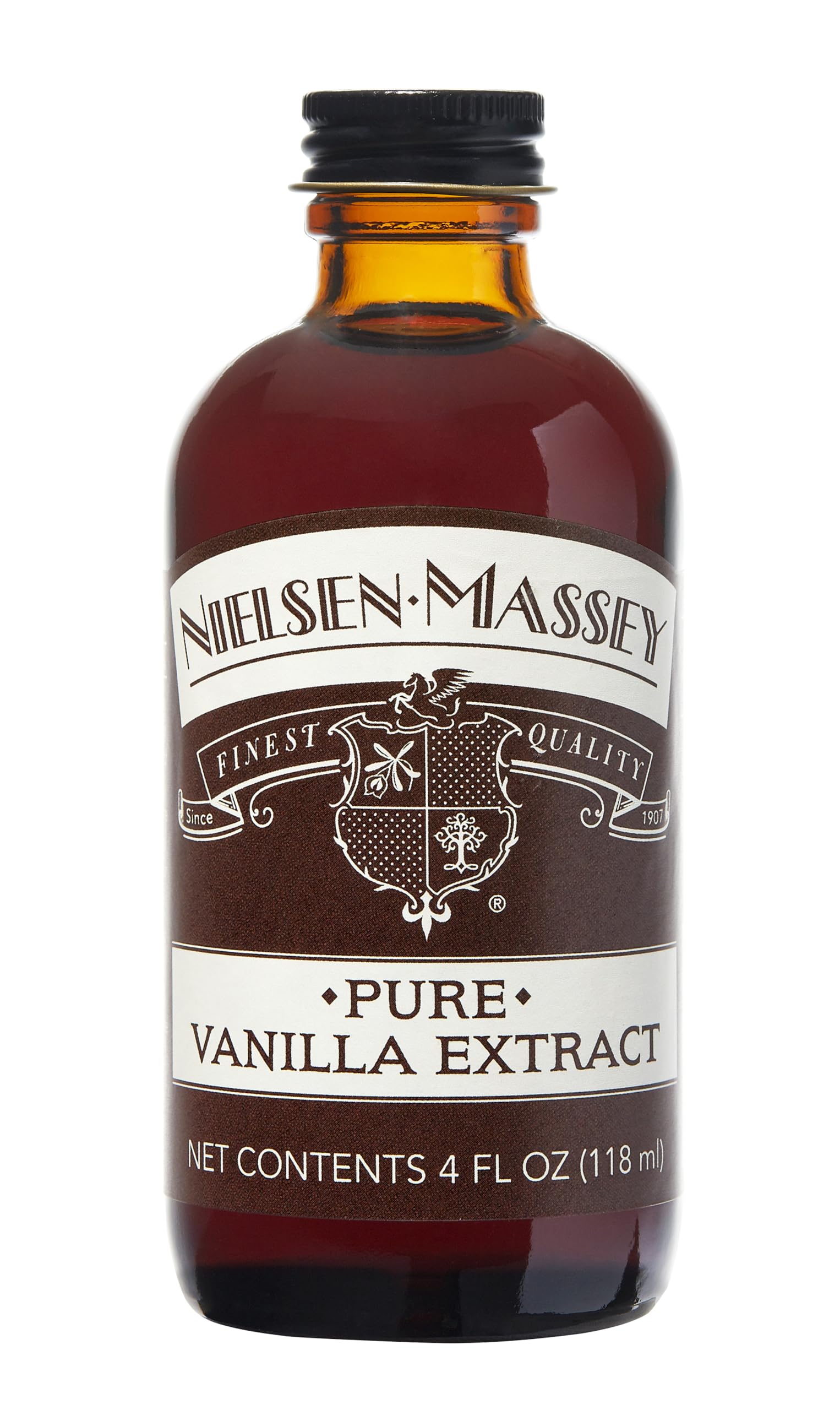
Nielsen-Massey
$17.45
In stock on Amazon
Check price on AmazonNielsen-Massey Pure Vanilla Extract is a blend. The company sources beans from multiple origins — primarily Madagascar, but also Tahiti and Mexico — and blends them to hit a consistent flavor profile year over year. This is the same strategy used by most high-quality extract producers: it buffers against single-origin crop variation and delivers a predictable, rounded vanilla flavor with good depth.
This is the format to reach for when consistency across batches matters more than provenance. If you’re producing cookie dough repeatedly, flavoring pastry cream for a standing menu item, or developing a signature buttercream that needs to taste identical in March and October, the multi-origin pure extract is your hedge against crop-year variation. Cook’s Illustrated, in their vanilla extract tasting, identified this class of blended multi-origin extract as the most reliable choice for everyday baking applications precisely because of that built-in consistency.
Best for: Cookie doughs, standard cake batters, buttercreams where flavor consistency batch-to-batch is the priority, any application where vanilla is a supporting flavor rather than the headliner.
Nielsen-Massey
$17.45
In stock on Amazon
Check price on AmazonThe Madagascar Bourbon Extract: Single-Origin Showcase
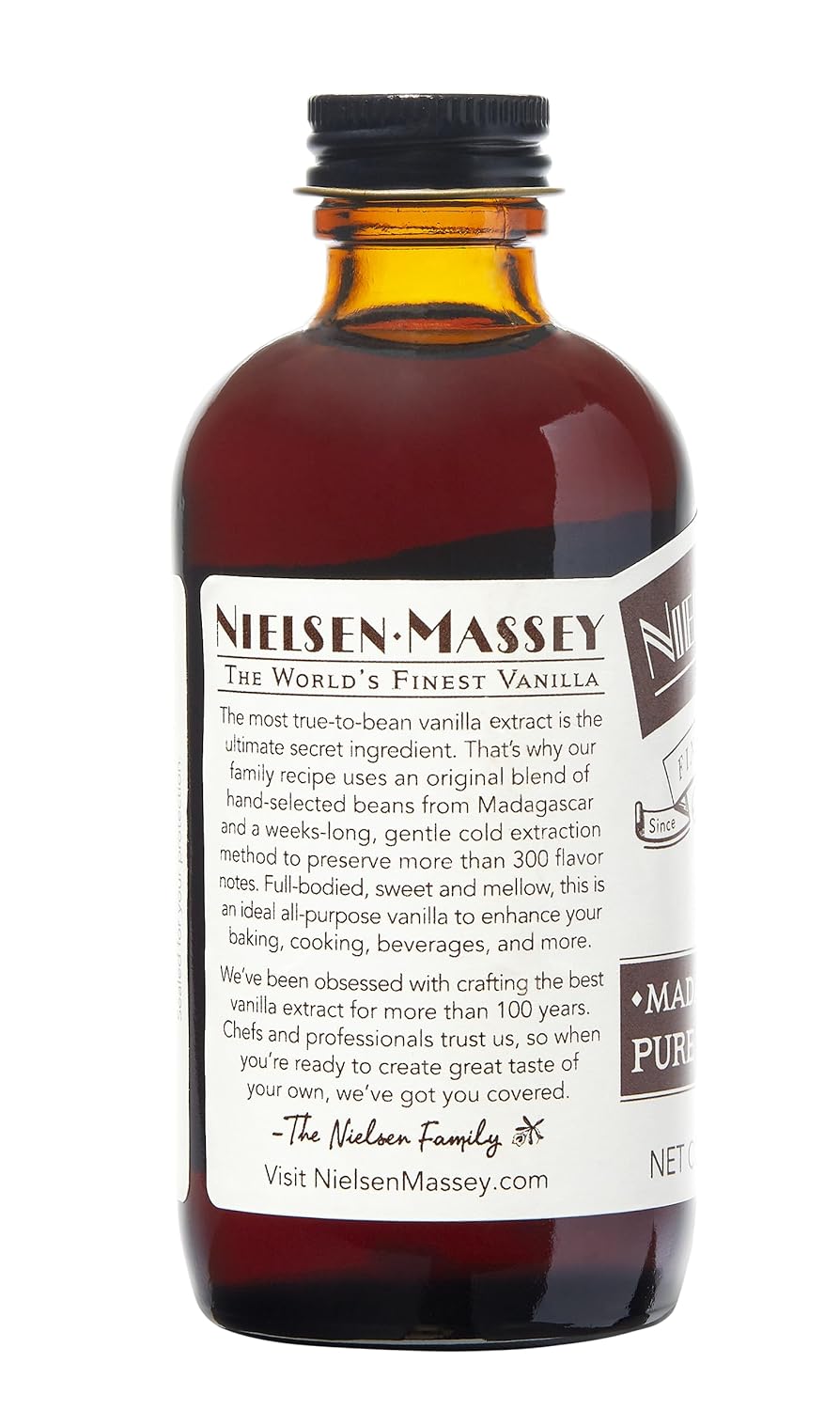
Nielsen-Massey
$18.97
In stock on Amazon
Check price on AmazonNielsen-Massey Madagascar Bourbon Pure Vanilla Extract is single-origin, sourced exclusively from beans grown in Madagascar. The “Bourbon” designation refers to Bourbon Island — now called Réunion — where the original planting stock came from. It is not a reference to whiskey.
Per Nielsen-Massey’s published product specification sheets, Madagascar Bourbon vanilla is characterized by a creamy, sweet, full-bodied flavor with a slightly stronger aromatic presence than a multi-origin blend. Cook’s Illustrated, in their vanilla extract tasting, described this flavor profile as representing the “classic American vanilla flavor” that most bakers expect — the benchmark against which other extracts tend to be measured.
The tradeoff versus the pure blend is straightforward: the Madagascar Bourbon extract carries a tighter, more identifiable flavor identity at the cost of some year-to-year variability as individual harvests differ. If you’re developing a premium product where origin is part of the label story, or preparing a vanilla-forward dish where the flavor itself is the showcase — a vanilla custard tart, a plain shortbread, a crème anglaise — this is the format worth the slight premium. Neither extract is categorically superior; the question is whether you’re optimizing for consistency or for flavor specificity.
Best for: Single-origin flavor showcases, premium SKU development where provenance is part of the label claim, vanilla-forward low-heat applications like custards and pastry cream.
Nielsen-Massey
$18.97
In stock on Amazon
Check price on AmazonVanilla Bean Paste: When the Specks Are Part of the Product
Nielsen-Massey
$18.97
In stock on Amazon
Check price on AmazonVanilla bean paste occupies a genuinely different functional tier than extract. It’s thicker — made from vanilla extract combined with ground vanilla bean seeds and a natural thickener — and it delivers those distinctive black specks that signal “real vanilla” to anyone looking at a cross-section of panna cotta, a pastry cream, or a frosted layer cake.
Epicurious, in their piece “Vanilla Bean Paste Is the Upgrade Your Baking Needs,” identified the paste format as the preferred choice for finished, visible applications where the visual cue of real bean specks carries meaningful consumer-facing value. That assessment holds up well across practitioner experience.
Concentration note: Nielsen-Massey’s vanilla bean paste is substituted 1:1 with pure extract by volume — one teaspoon of paste for one teaspoon of extract. However, because the paste contains actual ground bean material in addition to extract, the flavor profile tends to read as richer and more intensely vanilla-forward than liquid extract at the same volume. The Spruce Eats, in their “Best Vanilla Extracts for Baking” roundup, noted that paste delivers a more complex aromatic profile at equivalent doses compared to standard liquid extract.
Where paste wins decisively:
- Buttercreams, frostings, and anything served at room temperature where specks are visible and desirable
- Crème brûlée, panna cotta, and set custards
- Ice cream bases and gelato where a “bean-forward” label claim is part of the product identity
- No-bake fillings and mascarpone-based desserts where visual impact without additional liquid volume is useful
Where liquid extract is still the better call:
- Thin batters (chiffon cake, crepe batter) where the paste’s thickener can subtly affect texture at higher volumes
- White or very light-colored frostings where specks are aesthetically unwelcome
- Applications where you’re measuring to fraction-of-teaspoon precision and paste viscosity makes consistent dosing harder
- Cold beverage applications where clean suspension matters — the paste disperses with stirring in warm liquids but doesn’t dissolve cleanly in cold ones
Best for: Frostings, custards, ice cream bases, panna cotta, any finished surface application where visible bean specks carry consumer-facing value.
Nielsen-Massey
$18.97
In stock on Amazon
Check price on AmazonThe Almond Extract Case: Why This Format Has a Dedicated Following
Nielsen-Massey’s almond extract doesn’t get as much headline attention as their vanilla line, but among practitioners who work with almond flavor seriously, it generates some of the most emphatic loyalty in the brand’s portfolio.
Almond extract is made from the essential oil of bitter almonds — or, in many commercial versions, from benzaldehyde derived from stone fruits — suspended in alcohol. The key variable across brands is concentration and the quality of the carrier. Low-quality almond extracts tend to have a harsh, almost chemical edge from inferior benzaldehyde sourcing, while well-made versions deliver a cleaner, more natural stone-fruit-forward profile.
Serious Eats, in “The Best Vanilla Extracts, Tested and Reviewed,” noted that flavoring extract intensity and aromatic quality vary dramatically by brand, with mass-market grocery-store versions frequently delivering thinner and more synthetic flavor profiles than professional-grade alternatives. That observation applies directly to almond extract: the distinction between Nielsen-Massey and a standard grocery-store almond extract is not just a matter of intensity — it’s the absence of synthetic harshness at higher concentrations.
Practical application notes:
- In amaretti-style cookies and marzipan work, the higher effective concentration means you can often use slightly less by volume — relevant if you’re scaling a commercial recipe where flavor cost matters
- In layer cake applications alongside vanilla, Nielsen-Massey almond extract is frequently cited by pastry professionals as a complement to vanilla rather than a competing flavor
- Heat stability is solid: the alcohol carrier volatilizes in baking, but the benzaldehyde aromatic compounds survive standard baking temperatures without significant degradation, per Nielsen-Massey product documentation
- For cold beverage applications — flavored syrups, craft beverage bases, flavored dairy — the aromatic compounds in Nielsen-Massey almond extract are soluble without heat, expanding its utility beyond conventional baked goods
Practitioners who run direct comparisons between Nielsen-Massey almond extract and standard grocery-store alternatives consistently report needing slightly less Nielsen-Massey to hit the same flavor intensity — suggesting a meaningful effective concentration advantage. More importantly, reviewers describe the flavor character as cleaner at equivalent intensity levels: more genuine stone-fruit, less synthetic chemical edge.
Format Comparison at a Glance
The table below summarizes the core tradeoffs across the four Nielsen-Massey formats most relevant to baking and production work.
| Format | Substitution Ratio | Visible Bean Specks | Year-to-Year Consistency | Best Use Case |
|---|---|---|---|---|
| Pure Vanilla Extract (blend) | 1 tsp = 1 tsp | No | High (multi-origin blend) | Everyday batters, doughs, buttercreams Nielsen-Massey — $17.45 |
| Madagascar Bourbon Extract | 1 tsp = 1 tsp | No | Moderate (single-origin) | Vanilla-forward showcases, premium labels Nielsen-Massey — $18.97 |
| Vanilla Bean Paste | 1 tsp = 1 tsp | Yes | High | Frostings, custards, ice cream, visible surfaces Nielsen-Massey — $18.97 |
| Pure Almond Extract | Use ~20% less by volume | No | High | Marzipan, amaretti, layer cakes, beverage bases Nielsen-Massey — $18.97 |
The Availability Problem and Format Economics
Multiple editorial sources, including The Spruce Eats in their vanilla extract roundup, have flagged that Nielsen-Massey products are inconsistently stocked in standard grocery channels. This is worth taking seriously as a supply chain consideration, not just a consumer convenience issue.
If you’re a small-batch producer whose formula depends on Nielsen-Massey, local sourcing creates a single point of failure. The practical solution is sourcing through specialty food retailers online, which also unlocks larger format sizes — 4 oz, 8 oz, and 32 oz bottles for the extracts — that deliver meaningfully better cost-per-use economics than the 2 oz bottles typically stocked at retail.
Cost-per-use math, simplified: The 2 oz bottle of Nielsen-Massey vanilla extract typically retails in the $18–$22 range. The 8 oz bottle runs approximately $30–$38 through specialty online sources. At equivalent per-ounce pricing, the larger format saves roughly 30–40% per teaspoon compared to buying 2 oz bottles repeatedly. For a cottage bakery running through 8–16 oz of vanilla extract per month, that differential compounds meaningfully over a year. FlavoringStore.com stocks the core Nielsen-Massey formats, including larger bottle sizes not available at most grocery chains.
Frequently Asked Questions
Is Nielsen-Massey vanilla extract worth the higher price compared to standard grocery brands?
Across editorial evaluations — including coverage from Serious Eats and The Spruce Eats — the consistent finding is that Nielsen-Massey outperforms standard grocery-store extracts in flavor complexity and aromatic depth, particularly in low-heat or no-bake applications where vanilla flavor isn’t masked by caramelization. In heavily spiced or chocolate-dominant baked goods, the difference narrows. For vanilla-forward applications — sugar cookies, vanilla buttercream, pastry cream, plain shortbread — the price difference is consistently described as justifiable.
What is the practical difference between the Madagascar Bourbon extract and the pure vanilla extract?
The Madagascar Bourbon extract is single-origin; every bean comes from Madagascar. The pure vanilla extract is a multi-origin blend, weighted toward Madagascar but incorporating Tahitian and Mexican beans for consistency. The Madagascar Bourbon tends to read as slightly richer and more classically “American vanilla” in flavor. Per Nielsen-Massey’s product specification sheets, both use the same cold extraction process — the difference is origin selection and blending, not processing method.
Can vanilla bean paste be used in drinks?
It can be used in warm liquid applications — flavored milk drinks, warm sauces, hot beverages — where it disperses with stirring and delivers visible bean specks. For cold beverage applications where clarity or clean suspension matters, the liquid extract performs better. The paste’s thickener does not dissolve cleanly in cold liquids.
How much more intense is Nielsen-Massey almond extract compared to standard grocery brands?
Practitioners who maintain multiple brands for direct comparison consistently describe Nielsen-Massey as meaningfully more concentrated and cleaner in profile. The more important distinction is qualitative: the absence of synthetic harshness present in cheaper versions, which makes Nielsen-Massey almond extract more usable at higher concentrations without flavor degradation.
The Decision Rule
If your application is vanilla-forward, low-heat, or involves visible finished surfaces: use paste for showcase applications, Madagascar Bourbon extract where provenance is part of the label story, and the multi-origin pure extract for everything that needs to taste identical batch after batch.
If you’re building a serious almond-flavor application and currently using a grocery-store brand: switch to Nielsen-Massey almond extract, reduce your volume slightly, and expect a cleaner result at equivalent intensity. Practitioners who run that comparison consistently stay with it.
The brand has earned its reputation over more than a century of processing. The formats serve genuinely different functions. Know which problem you’re solving, buy the size that fits your usage rate, and source online if local availability is unreliable.