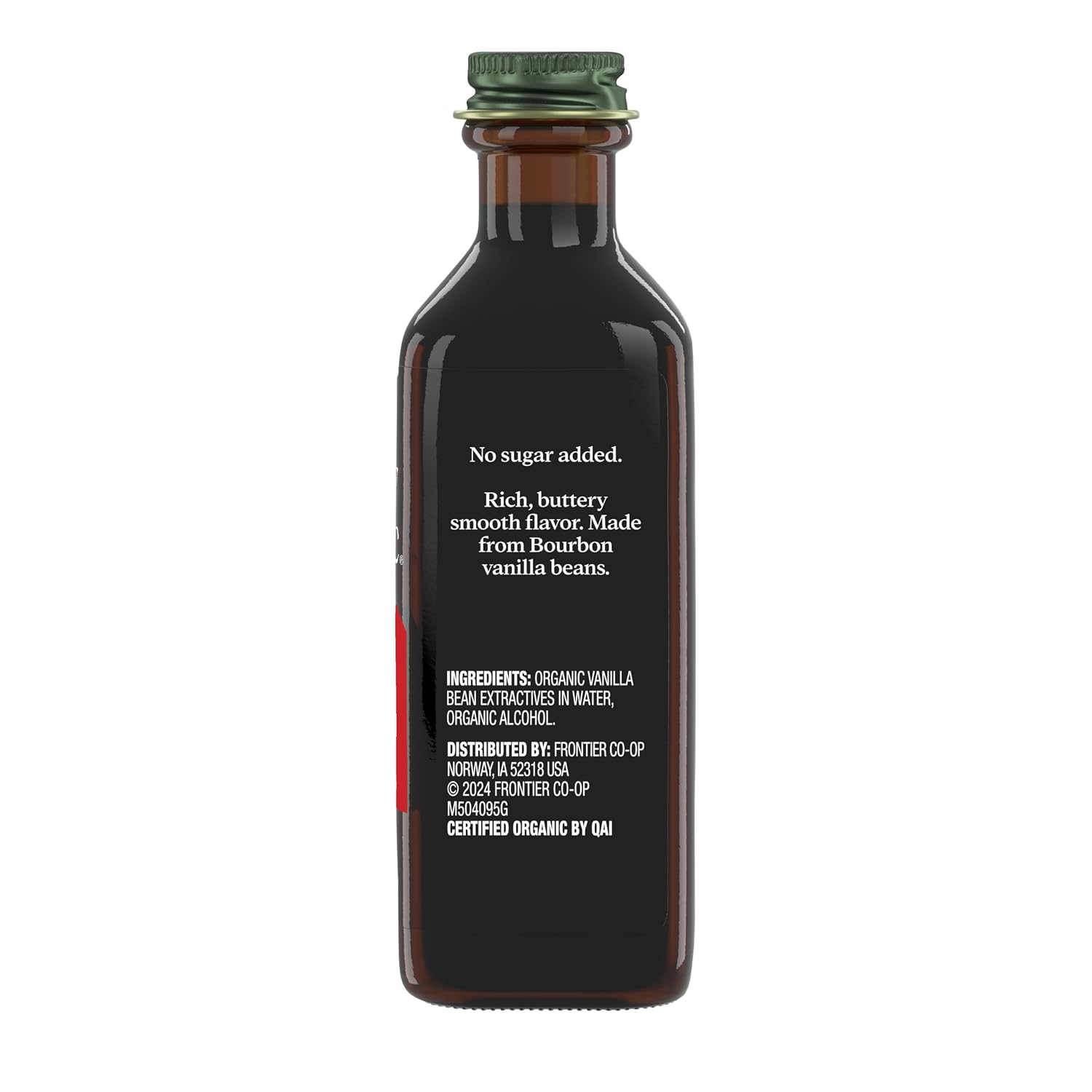
Vanilla extract is simply alcohol that has been used to pull flavor compounds out of cured vanilla beans — the FDA’s standard of identity (that’s the legal recipe the government requires a product to follow before it can be called “vanilla extract”) specifies a minimum of 13.35 ounces of vanilla beans per gallon of liquid, at 35% alcohol. “Organic” certification, administered in the U.S. by the USDA’s National Organic Program, adds a second layer of requirements on top of that: the beans must be grown without synthetic pesticides or fertilizers, and the alcohol used for extraction must also come from a certified organic source. That sounds straightforward, but as soon as you start pricing shelf options against each other — say, a 4-ounce bottle at $12 versus an organic equivalent at $22 — you’re right to wonder whether the premium is paying for something that matters in the finished product, or whether it’s mostly a label you’re passing the cost of to your customers.
This article is for people who are past the “just grab a bottle” stage and are now making sourcing decisions with real implications: scaling a recipe for a cottage bakery, locking in a house flavoring for a craft beverage line, or advising a client on ingredient specs. We’ll walk through what organic certification actually controls, where it genuinely changes the product, where it doesn’t, and which brands consistently earn their price tags based on published specs and aggregated user and professional reviews.
What Organic Certification Actually Controls — and What It Doesn’t
Start here, because this is where most buying decisions go wrong.
The USDA National Organic Program certification governs two things in an organic vanilla extract: the agricultural inputs used to grow the beans, and the certification status of any non-water ingredients (primarily the extraction alcohol). It does not regulate flavor compound concentration beyond the FDA’s standard-of-identity floor, it does not specify bean origin or variety (Madagascar Bourbon, Tahitian, and Mexican vanilla all qualify), and it says nothing about aging time or processing method after extraction.
This matters enormously for the flavor question. The aromatic complexity of a vanilla extract comes from hundreds of volatile compounds — vanillin is the loudest, but heliotropin, coumarin precursors, guaiacol, and dozens of others shape the finished profile. Per the FDA’s CFR Title 21 Part 169 standards, a “pure” conventional extract and a “pure” organic extract must meet the same bean-to-alcohol ratio floor. The organic version isn’t legally required to contain more beans, better-cured beans, or longer-extracted beans. A bare-minimum organic extract can legally smell less complex than a premium conventional one.
The practical takeaway: organic certification is a farming and processing-chain claim, not a flavor-quality claim. The two things can travel together in the same bottle, but they don’t have to.
By the numbers:
| Factor | Controlled by Organic Cert? | Controlled by FDA Standard of Identity? |
|---|---|---|
| Bean farming inputs (pesticides, fertilizers) | ✅ Yes | ❌ No |
| Extraction alcohol source | ✅ Yes | ❌ No |
| Bean-to-liquid ratio (minimum) | ❌ No | ✅ Yes |
| Flavor compound concentration | ❌ No | ❌ No |
| Bean origin or variety | ❌ No | ❌ No |
The Real Cases Where Organic Certification Matters
With all that said, there are legitimate reasons to pay the premium — they just might not be the ones you assumed.
Clean-label product claims. If your finished product carries an organic or “made with organic ingredients” claim on packaging, your flavoring inputs need to be certified to back that up. This is a legal compliance issue, not a preference one. USDA rules under 7 CFR Part 205 require that if you use the organic seal or specific percentage claims, your flavor inputs must come from certified sources. For cottage food operators and specialty food entrepreneurs heading toward retail placement, this is often the deciding factor regardless of flavor comparison.
Ingredient provenance as brand story. For a craft soda developer or artisan bakery whose customer base actively reads labels and pays for supply-chain transparency, “certified organic Madagascar vanilla” is a marketing asset with real dollar value. That’s not cynical — it’s audience alignment. Reviewers and food writers at outlets like Serious Eats and Bon Appétit have repeatedly noted that provenance storytelling increasingly drives premium positioning for small-batch food brands in 2025–2026.
Pesticide residue reduction. This is the agronomic argument for organic. Vanilla vines are hand-pollinated and labor-intensive crops primarily grown in Madagascar, Tahiti, Indonesia, and Uganda, where agricultural input regulation varies widely. A 2023 European Food Safety Authority monitoring report (cited in several food-trade publications) identified pesticide residues in a portion of conventional imported vanilla products. The organic certification chain is meant to close that gap. For formulators producing for sensitive populations — children’s products, allergen-conscious lines — this may carry weight.
What doesn’t meaningfully change: If your operation produces items where the vanilla is baked at 325°F or higher, or incorporated into a heavily sweetened base where delicate aromatic volatiles dissipate anyway, the difference between a well-made conventional pure extract and an organic one at the same fold strength (the industry shorthand for concentration — a 2-fold extract contains twice the bean extract of a 1-fold) is unlikely to survive the process. Cook’s Illustrated’s vanilla extract evaluation consistently finds that in baked applications, differences between premium pure extracts — organic or not — narrow significantly compared to their side-by-side differences in raw applications.
Which Organic Brands Actually Deliver on Flavor
This is where the decision tree narrows. There’s a meaningful quality spread among certified organic options, and brand selection matters more than the organic label itself.
Nielsen-Massey Pure Vanilla Extract (Organic line) Nielsen-Massey’s organic Madagascar Bourbon extract is one of the most consistently cited products in professional baking circles. Published manufacturer documentation specifies cold-processing — a proprietary extraction method the company claims preserves a broader range of flavor compounds compared to heat-assisted extraction. Serious Eats’ vanilla extract review rates the Nielsen-Massey Madagascar line as a benchmark for complexity, and their organic version delivers a comparable profile in aggregated professional reviews: rich, slightly creamy, with good staying power in both raw and baked applications. Retail pricing in mid-2026 runs approximately $22–$28 for 4 ounces, putting cost-per-use at roughly $0.40–$0.55 per teaspoon. For operations buying in volume (8-ounce and 32-ounce formats are available), the per-use cost steps down meaningfully.
Heilala Vanilla (Certified Organic) Heilala sources primarily from Tonga and has built a strong direct-trade and sustainability narrative that goes beyond USDA certification alone. Their organic extract is frequently cited in baker community reviews for a distinctive floral, slightly stone-fruit note that differentiates it from Madagascar-dominant profiles — a relevant consideration if you’re developing flavors where vanilla is a featured note rather than background warmth. Heilala’s own manufacturer documentation is unusually transparent about their bean sourcing and alcohol base, which matters for formulators who need to document supply chains. Price per ounce runs higher than Nielsen-Massey — expect $6–$8/oz retail — making it a considered purchase for small-batch finishing use rather than everyday volume applications.
Frontier Co-op Organic Vanilla Extract For operations where budget matters more than maximum complexity, Frontier’s USDA-certified organic extract is widely available and represents a functional choice in the $12–$16 per 4-ounce range. Aggregated reviews on natural food retail platforms describe it as clean and reliable without the layered complexity of Nielsen-Massey or Heilala. It performs well in applications where vanilla is supporting rather than starring — spice blends, compound frostings, baked goods with strong competing flavors. The Spruce Eats and similar comparative guides note it as a solid “everyday organic” pick.
A note on fold strength: Most retail organic extracts are 1-fold (1x). If you’re scaling a recipe that calls for 2-fold or double-strength extract (common in commercial candy and beverage development), verify fold strength on the label — paying an organic premium for a 1-fold when your formula was developed with 2-fold will leave you with flat flavor and a confusing result.
The Substitution Math When Organic Isn’t Available
Supply chain disruptions for vanilla — a recurring challenge given that Madagascar produces roughly 80% of global vanilla supply, per multiple commodity-market tracking reports — occasionally pull specific organic SKUs from availability. Here’s a practical substitution framework:
- Organic 1-fold → Conventional pure 1-fold: Acceptable in most baked applications where the organic certification isn’t a labeling requirement. Flavor loss is minimal if you match bean origin. Add 10–15% more volume if your conventional extract seems thinner in raw taste.
- Organic extract → Organic vanilla bean paste: Nielsen-Massey and Heilala both offer certified organic paste formats (vanilla seed-flecked paste at approximately 1:1 substitution ratio). Paste retains more aromatic complexity through heat and is visually distinctive in finished products. Cost per use is higher; worth it for premium positioning.
- Organic → Non-extract format for label compliance: If you need the organic certification for a label claim and your preferred extract is out of stock, certified organic vanilla powder (available from OliveNation and bulk botanical suppliers) can substitute in dry applications at roughly 1/2 teaspoon powder per 1 teaspoon extract.
The Decision Rule
If you’ve read this far, you’re probably making one of three calls:
If your product carries or will carry an organic label claim → you must use certified organic vanilla, and Nielsen-Massey’s organic line is the safest combination of compliance, flavor quality, and supply reliability at mid-scale volumes.
If organic certification is a brand story asset for your audience but not a legal requirement → Heilala’s organic extract is worth the price premium specifically because their origin documentation and flavor differentiation give you something to talk about. Budget for small-batch finishing use; supplement with a conventional pure extract for bulk applications.
If you’re buying organic primarily because you believe it tastes better → go back to the concentration and fold-strength data first. A well-sourced conventional 2-fold pure extract from Nielsen-Massey or a specialty supplier will outperform a certified organic 1-fold in nearly any baked or heat-processed application. Spend the premium dollars on fold strength before you spend them on certification.
The certification is real and the reasons for it are legitimate — clean-label compliance, supply-chain transparency, agronomic standards. What it isn’t is a guarantee of flavor superiority. Match the purchase to the actual requirement, and you’ll make the better call every time.