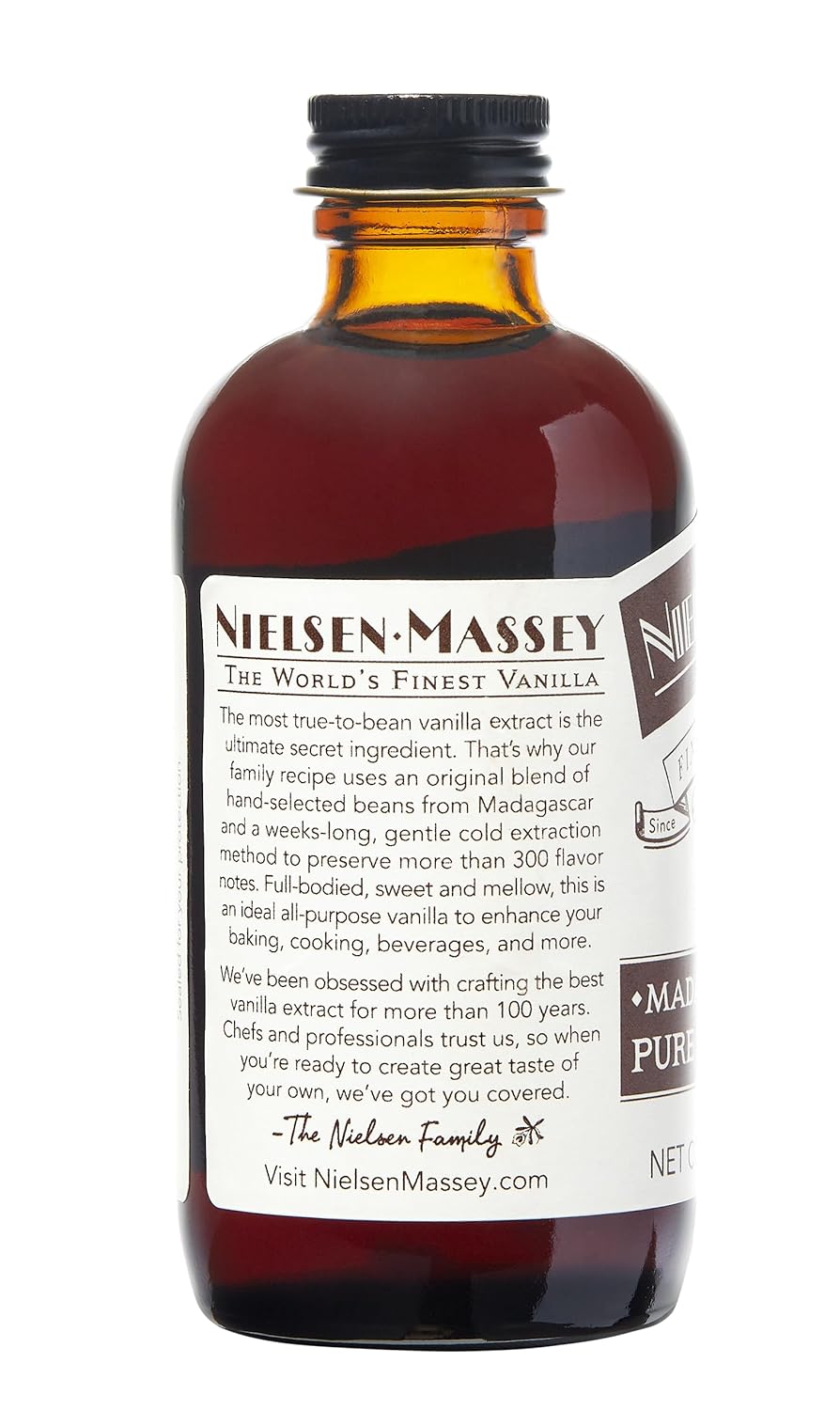
If you’ve ever stood in a baking aisle — or scrolled through a supplier catalog — trying to decide between a $7 bottle and a $28 bottle of pure vanilla extract, you already know the frustration. Both say “pure vanilla extract” on the label. Both smell pretty good when you crack the lid. But the price gap doesn’t always tell you what you’re actually getting. Here’s the key thing to understand: vanilla extract is made by soaking vanilla beans (the seed pods of the Vanilla planifolia orchid) in an alcohol-and-water solution. The FDA, per its Code of Federal Regulations Title 21 Part 169, sets a legal minimum — any product sold as “pure vanilla extract” in the United States must contain at least 13.35 ounces of vanilla beans per gallon of liquid. That’s called single-fold, or 1x concentration. Beyond that baseline, brands can go higher — 2x, 3x, even 4x fold — and the price-per-teaspoon math shifts dramatically. This article breaks down how to compare bottles on actual value, not sticker price, and gives you a clear decision rule for which product earns a spot in your production workflow.
| EDITOR'S PICK[Kirkland Signature Pure Vanilla](https://www.amazon.com/dp/B00JW1OHWK?tag=greenflower20-20) | Mid-tier[Nielsen-Massey Madagascar Bourb…](https://www.amazon.com/dp/B000GAWH4G?tag=greenflower20-20) | Budget pick[Simply Organic Pure Madagascar…](https://www.amazon.com/dp/B0002UN7PI?tag=greenflower20-20) | |
|---|---|---|---|
| Size | 16 oz | 4 oz | 4 oz |
| Origin | — | Madagascar | Madagascar |
| Organic | — | — | ✓ |
| Price | $20.99 | $18.97 | $13.96 |
| See on Amazon → | See on Amazon → | See on Amazon → |
What “Fold” Actually Means — and Why It Changes the Math
Fold strength is the single most important number on a vanilla extract spec sheet, and most retail bottles bury it or don’t list it at all. Here’s the simple version: a 2-fold (2x) extract contains twice the vanilla bean extraction per unit volume as a standard single-fold product. In practical terms, you need roughly half as much to achieve the same flavor intensity in a recipe.
The FDA’s standard of identity (Title 21, Part 169) defines single-fold as the baseline, and anything above that is technically a “concentrated” or “multi-fold” extract. Some manufacturers label clearly — Nielsen-Massey, for example, explicitly identifies its products as single-fold on specification documentation. Others, particularly value-tier brands, rely on the legal minimum and don’t advertise it prominently.
For a home baker making one batch of cookies a week, this is a minor inconvenience. For a small-batch candy operation running 50-gallon batches, or a beverage developer calibrating a syrup formula, using the wrong fold strength without adjusting your usage rate creates inconsistency across production runs. The rule of thumb: if fold strength isn’t printed on the label or available in the brand’s spec documentation, assume single-fold and plan accordingly.
Cost-Per-Use: Running the Numbers Across the Key Tiers
This is where the $7 bottle usually loses, even if it wins at the register. Let’s look at the math across three common product tiers using approximate 2025–2026 market pricing.
By the Numbers
| Product | Approx. Price | Size | Fold | Est. Cost per Tsp |
|---|---|---|---|---|
| Generic store-brand pure vanilla | $7–$9 | 4 fl oz | 1x | ~$0.44–$0.56 |
| Nielsen-Massey Pure Vanilla Extract | $18–$30 | 4–8 fl oz | 1x | ~$0.56–$0.94 |
| Heilala Pure Vanilla Extract | $22–$32 | 3.4 fl oz | 1x | ~$0.97–$1.41 |
| Nielsen-Massey 2-fold (professional size) | $55–$75 | 32 fl oz | 2x | ~$0.17–$0.23 |
(Price ranges reflect aggregated supplier and retailer data as of mid-2026. Your actual cost-per-use depends on application rate and batch scaling.)
The 32-ounce professional-size Nielsen-Massey 2-fold bottle looks expensive at the shelf — and it is, in absolute dollars. But on a per-teaspoon basis, it lands at roughly $0.17–$0.23, versus $0.56–$0.94 for the same brand’s retail single-fold bottle. If your weekly production volume clears 20+ teaspoons of vanilla usage (a modest threshold for any commercial baker), the large-format 2x product pays back its premium within the first month.
The generic store-brand bottle looks cheapest at first glance. But Serious Eats’ vanilla extract evaluation notes that flavor complexity and aromatic persistence — the factors that determine whether vanilla reads as a background note or a featured flavor — vary substantially between single-fold products, even at the same nominal concentration. The FDA minimum gets you legal compliance, not flavor parity.
Brand Profiles: Where Quality and Concentration Actually Diverge
Nielsen-Massey is the most widely cited professional benchmark in baking and confectionery applications. Cook’s Illustrated’s vanilla evaluations consistently place Nielsen-Massey Pure Vanilla Extract at or near the top for flavor complexity and consistency across baked applications. Spec documentation from the company confirms single-fold concentration for retail products, with multi-fold options available in professional volumes. The vanilla is cold-processed, which Nielsen-Massey’s own documentation states preserves more of the 250+ flavor compounds found in vanilla beans — a claim consistent with flavor chemistry literature, though independent sensory confirmation varies by application.
Heilala Vanilla occupies the single-origin premium niche. Sourced from Tonga, Heilala’s vanilla products emphasize traceable provenance and a flavor profile that reviewers across specialty food publications describe as more floral and less one-dimensionally sweet than Madagascar Bourbon vanilla. Heilala’s product documentation lists their extract as single-fold. At a cost-per-teaspoon that’s often the highest in the retail tier, Heilala makes the most sense for applications where vanilla is a featured — not background — flavor: custards, pastry creams, or a craft beverage where the vanilla note needs to stand alone. The premium is harder to justify when vanilla is one of twelve ingredients in a complex flavor formula.
LorAnn Oils’ vanilla products serve a different use case. Their concentrated vanilla flavor (not a pure extract — an important distinction) is designed for high-heat applications like hard candy and chocolates, where alcohol-based extracts can volatilize during cooking and lose significant flavor. LorAnn’s product documentation lists their super-strength flavors as approximately 3–4x the concentration of standard extracts. For candy makers specifically, this isn’t an apples-to-apples comparison with pure extract — it’s a separate category that often wins on heat stability grounds regardless of price.
The Flavor Apprentice and similar flavor-house suppliers offer vanilla concentrates and flavoring blends in bulk formats that professional formulators price differently: by the kilogram, with concentration specs expressed as usage percentages. Per The Flavor Apprentice’s published spec sheets, their vanilla custard and vanilla bean concentrate products are designed at usage rates of 0.5–2% of total formula weight, making direct comparison to retail extract volumes unintuitive but straightforward once you’ve run the conversion.
Heat Stability: The Variable That Overrides Cost Math
Cost-per-use analysis is only meaningful when the product survives your process. Pure vanilla extract — all of it, at every price point — is alcohol-based. The flavor compounds in vanilla extract are volatile, meaning they evaporate with heat. The practical consequence: in a recipe that bakes at 350°F for 45 minutes, a meaningful portion of the vanilla’s aromatic impact will off-gas during cooking.
This is not a defect or a quality failure. It’s chemistry. But it’s a variable that changes the decision matrix significantly:
- No-bake or low-heat applications (whipped cream, pastry cream, cold-process ganache, beverages): pure vanilla extract performs at full strength. This is where Heilala’s flavor complexity and Nielsen-Massey’s consistency shine, and where higher cost-per-use is most justifiable.
- Moderate-heat applications (cake batters, cookie doughs, custard bases cooked to 170–180°F): extract works well, but you may want to slightly increase your usage rate — roughly 1.25x — to compensate for some volatilization.
- High-heat applications (hard candy, pulled sugar, chocolate tempering): vanilla extract’s alcohol carrier is largely gone before the product sets. For these applications, reviewers and candy-industry sources consistently recommend vanilla bean paste (which anchors flavor in a viscous base), powdered vanilla, or oil-soluble vanilla concentrates like LorAnn’s.
Nielsen-Massey’s product documentation and the Serious Eats vanilla overview both note that vanilla bean paste — which includes ground vanilla bean specks suspended in a sugar-syrup base — holds flavor better in baked applications than straight extract, at the cost of visual specking and a slightly sweeter base. For a pastry operation where specks are a selling point (they read as artisanal and authentic), vanilla bean paste from Nielsen-Massey or Heilala can actually consolidate two SKUs into one.
The Decision Rule: If X, Then Y
At this point you have enough variables to feel confused rather than decisive. Here’s the simplified framework:
If you’re producing under 10 teaspoons per week (home bakery, test batching, small-scale cottage operation): buy a quality single-fold extract in retail size. Nielsen-Massey Pure Vanilla Extract or Heilala gives you a reliable flavor baseline without over-investing in volume. Don’t optimize cost-per-use when your inventory turnover is slow — vanilla extract’s alcohol-based formulation provides long shelf stability (USDA guidance generally cites 5+ years for pure extracts stored correctly, away from heat and light), but you still want product you’ll use within a reasonable period.
If you’re producing 10–50 teaspoons per week (small commercial bakery, regular candy production, beverage development with repeat batches): move to professional-size single-fold or step up to a 2-fold in 32-ounce format. The Nielsen-Massey professional size is the most commonly cited value pivot in this tier. Run the cost-per-use math against your current retail bottle before reordering — the breakeven point is usually within the first or second production month.
If your application involves high heat above 250°F: stop optimizing extract concentration and switch product categories. Vanilla bean paste for moderate-high heat baked goods; oil-soluble concentrate or vanilla powder for hard candy and pulled sugar. The best pure extract on the market loses to an appropriate specialty product in this environment.
If vanilla is your featured flavor, not a background note: pay the Heilala or Nielsen-Massey premium. Across aggregated reviews and published evaluations including Cook’s Illustrated’s panel tasting, flavor complexity differences between value and premium extracts are most detectable when vanilla is prominent — custards, simple syrups, vanilla-forward beverages. They’re hardest to detect when vanilla is one node in a complex flavor formula.
If you’re formulating at scale and measuring by weight, not volume: request spec sheets from The Flavor Apprentice, OOO Flavors, or your flavor house of choice and convert to usage percentages. Retail extract volume comparisons lose their relevance above a certain production threshold, and bulk concentrate pricing typically wins on pure economics before you even factor in concentration.
The bottle that “wins” isn’t universal — it’s the one that matches your production volume, application temperature, and flavor role. But for most practitioners in the $60–$150 annual vanilla spend range, the 2-fold professional-size pure extract is the inflection point where quality and value stop trading off against each other and start pointing in the same direction.