If you’ve ever grabbed a bottle of Watkins vanilla at the store and wondered whether you were holding something pure, artificial, or somewhere in between — you’re not alone. Vanilla extract is the flavored liquid made by soaking real vanilla beans in alcohol; imitation vanilla is a lab-derived substitute (usually vanillin, the main flavor compound in vanilla beans) that mimics the taste without the beans; and a baking blend sits between them, combining both sources. Watkins makes all three styles under branding that looks remarkably similar across formats, which is where most of the confusion starts. This article cuts through the label noise, compares the formats side by side on flavor performance, color, concentration, and cost-per-use, and tells you exactly which bottle to reach for based on what you’re making right now.
The short answer for anyone already mid-project: Watkins’ clear “Baking Vanilla” is a blend — real vanilla extractives plus imitation vanillin — engineered specifically to stay light in color while delivering a bolder flavor impact than straight imitation. If frosting color or cake crumb whiteness is your constraint, that matters enormously. If you’re in a pure-extract-only context (think label-forward artisan product), the pure version is a different animal entirely. Let’s map all three.
| EDITOR'S PICKWatkins Pure Almond Extract | Mid-tierWatkins All Natural Original Go… | Budget pickWatkins All Natural Original Go… | |
|---|---|---|---|
| Flavor | Almond | Vanilla | Vanilla |
| Volume | 32 fl oz | 11 fl oz | 8 fl oz |
| Vanilla type | — | Pure extract | Pure extract |
| Price | $25.85 | $12.35 | $8.98 |
| See on Amazon → | See on Amazon → | See on Amazon → |
The Three Bottles, Actually Explained
Watkins currently offers three distinct vanilla SKUs that routinely get conflated in reviews and on retailer shelves. Rather than treating them as interchangeable, each format deserves its own evaluation on flavor profile, legal classification, and best-fit application.
Watkins Pure Vanilla Extract
This product meets the FDA’s standard of identity for pure vanilla extract as defined in the Code of Federal Regulations, Title 21, Part 169 — Food Dressings and Flavorings: minimum 35% alcohol by volume and at least 13.35 ounces of vanilla beans per gallon of extracting liquid. It is dark brown, alcohol-prominent on the nose, and behaves like any quality pure extract. If a recipe specifies “pure vanilla extract” and you’re producing something you’ll sell or label for retail, this is the legally correct choice. The flavor profile includes the full spectrum of vanilla’s aromatic compounds — caramel-adjacent phenols, floral top notes, and the deeper woody undertones that vanillin alone cannot replicate.
The trade-off is color and cost. Dark pure extracts introduce visible amber tones into white or pale preparations, and per-teaspoon cost runs significantly higher than the blend formats. For applications where neither factor is a constraint — custards, pastry cream, vanilla bean sauce, cold-set desserts — this format delivers the most complete flavor picture.
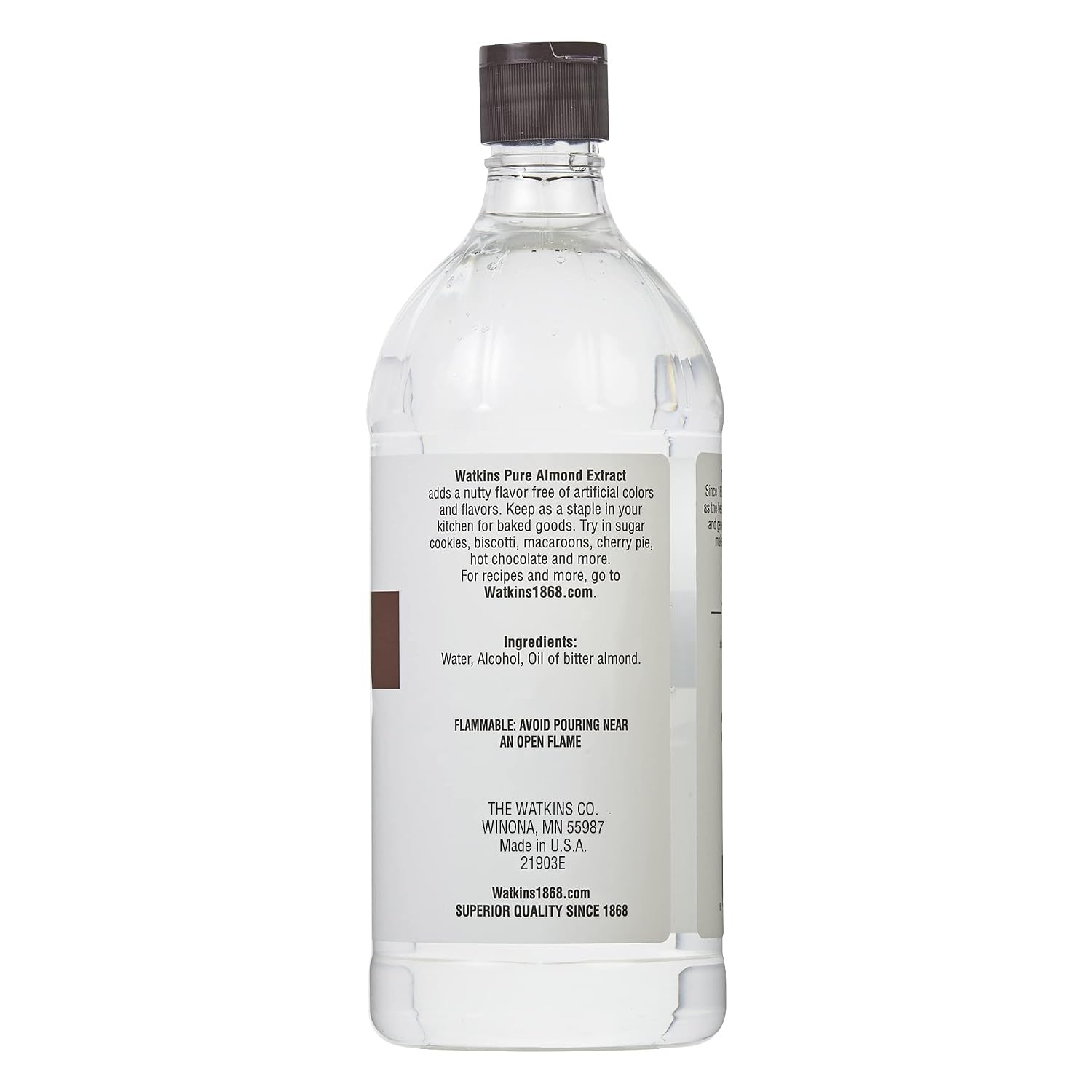
Watkins 21903
$25.85
In stock on Amazon
Check price on AmazonWatkins Original Baking Vanilla (the “clear” blend)
This is the product that generates the most discussion and the most label confusion. It is not a pure extract. It is a proprietary blend of real vanilla extractives and imitation vanillin, formulated without the full alcohol content required by the FDA’s pure extract standard. The result is a notably clear or very pale gold liquid — the source of its popularity in white cake and snow-white American buttercream applications.
Serious Eats, in their staff tasting and formulation guide “The Best Vanilla Extract,” notes that baked applications narrow the flavor gap between quality imitation and pure extract considerably, because heat volatilizes the delicate top-note compounds that most distinguish pure extracts in raw or minimally-processed preparations. That finding supports the Watkins baking blend specifically for cooked applications: bakers are not sacrificing as much flavor complexity as the “pure vs. imitation” framing implies when heat is involved.
The blend sits accurately in a middle position — meaningfully above generic imitation on flavor, below premium pure extract on aromatic depth, and uniquely competitive on color neutrality.
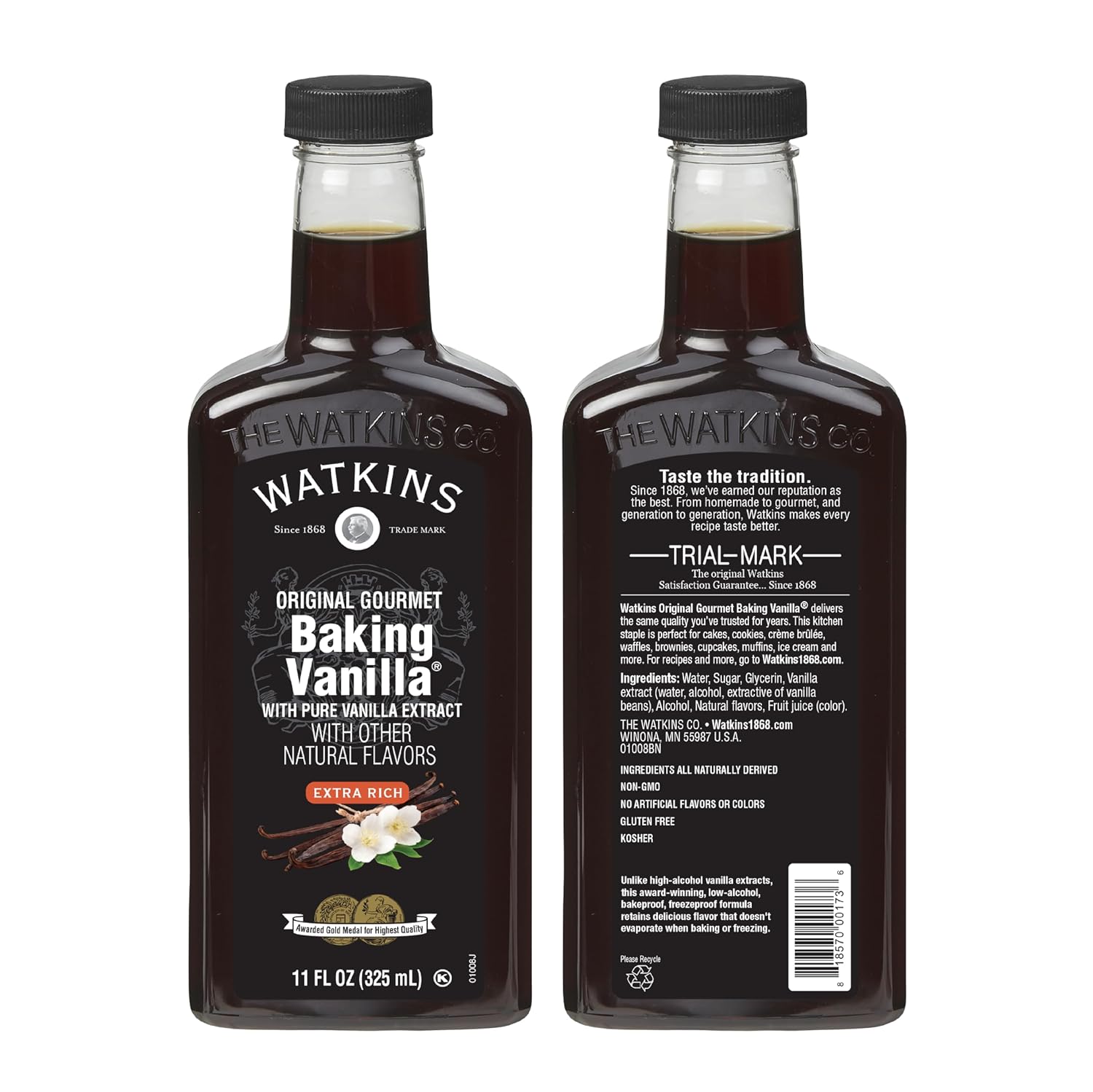
Watkins
$12.35
In stock on Amazon
Check price on AmazonWatkins Alcohol-Free Vanilla (2 oz)
This is a glycerin-based imitation vanilla with no alcohol carrier. It’s positioned for applications where alcohol is a constraint — baking for certain dietary needs, candy and confectionery work where alcohol burn-off timing matters, or no-bake preparations where residual alcohol flavor is unwanted. At 2 oz it is clearly targeted at home use rather than production volume.
Fine Cooking, in their “Vanilla Buying Guide,” establishes a useful framing for alcohol-free alternatives: glycerin-based vanilla flavoring carries flavor differently than alcohol-based extracts and should be treated as a distinct formulation variable rather than a direct swap. Glycerin is thicker, slightly sweet on its own (relevant where sweetness balance is precise), and releases flavor on a different timeline. In baked applications, alcohol carriers flash off during baking; glycerin does not flash off the same way, which can produce a slightly different flavor release profile in the finished product — not categorically worse, but different enough to warrant its own calibrated ratio.
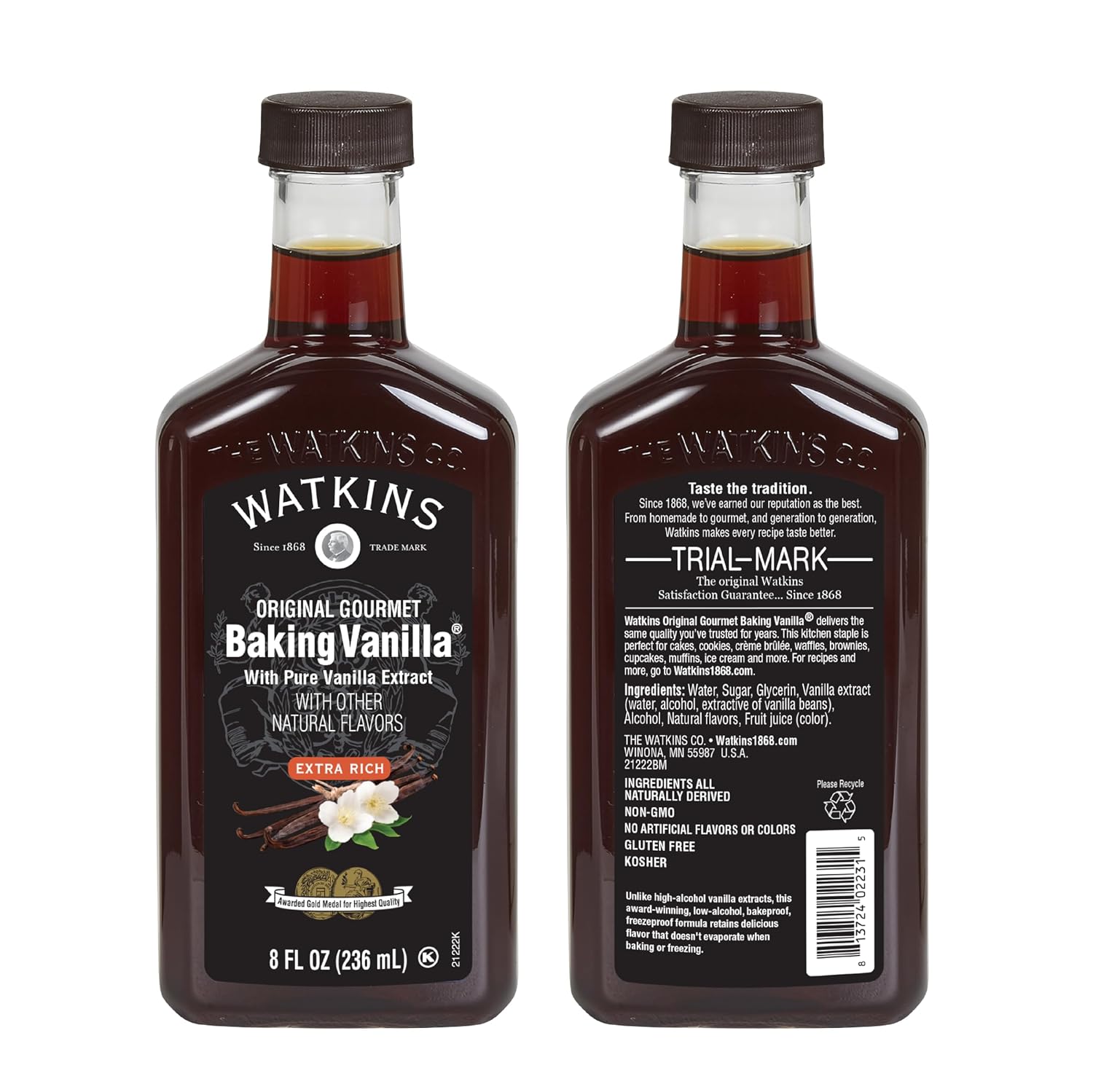
Watkins
$8.98
In stock on Amazon
Check price on AmazonWhy Color Is the Real Decision Driver for Most Bakers
For a significant segment of bakers — particularly those producing white wedding cakes, Swiss meringue buttercream, royal icing, or vanilla layer cakes where a pure snow-white interior matters — the amber color of standard pure vanilla extract is a genuine formulation problem, not a superficial concern. The Spruce Eats, in their ingredient explainer “What Is Imitation Vanilla and Should You Use It?”, addresses this directly, noting that color neutrality is among the primary practical reasons professional cake decorators reach for clear imitation or clear-blend vanilla products even when cost is not the constraint.
One teaspoon of a dark pure extract added to white royal icing will shift the color perceptibly. In a professional cake context, that is a quality-control issue. The Watkins Baking Vanilla’s clear formula addresses this directly. Across aggregated buyer reviews, the single most-cited reason for brand loyalty to this product is precisely this color advantage: bakers report it as their go-to for white wedding cakes and buttercream, noting that no dark pure extract can match it for color neutrality at any price point.
The flavor trade-off should be named clearly in your own formulation notes. Pure vanilla extract contains hundreds of flavor compounds beyond vanillin. Imitation vanillin delivers the “vanilla” impression cleanly but with less aromatic depth. The Watkins blend sits between these poles, which is why it consistently earns better flavor reviews than generic imitation while remaining distinct from premium pure extracts. For baked goods specifically — where Serious Eats’ vanilla extract tasting notes confirm that heat narrows the performance gap — this is a favorable trade-off for most production contexts.
Cost-Per-Use Math and the Storage Question
The 32 oz plastic bottle is where Watkins’ value proposition concentrates — and it’s also the source of the one consistent buyer concern worth addressing directly.
On cost-per-use, the math is straightforward. A 32 oz bottle yields approximately 192 teaspoons. At current 2026 market pricing, the per-teaspoon cost lands well below mid-tier pure extracts and roughly comparable to store-brand imitation vanilla — but with meaningfully better flavor output than generic imitation. Compared to McCormick Pure Vanilla Extract in standard retail sizes, Watkins Baking Vanilla comes in at roughly 25–40% of the cost per use depending on format. Cook’s Illustrated, in their vanilla extract comparison testing, has noted that price alone is a poor proxy for baked-good flavor in cooked applications — a finding that cuts in favor of value-oriented blends like Watkins when the end use involves heat.
The plastic container is a legitimate storage consideration, not a dealbreaker. Glass is the preferred long-term vessel for flavor concentrates because it is impermeable to oxygen and does not leach. The high-density polyethylene (HDPE) plastic standard for Watkins’ large-format bottles is food-safe and adequate for typical consumer use timelines. The Spruce Eats, in “What Is Imitation Vanilla and Should You Use It?”, notes that proper storage conditions — cool temperature, darkness, and a sealed cap — are the primary shelf-life variables regardless of container material. The plastic itself is a minor factor if turnover is reasonably fast.
The practical rule: if your production volume moves a 32 oz bottle in under six months, the plastic container is a non-issue. If you are a low-volume home baker buying it for the value and storing it for 18–24 months, transfer it to a dark glass bottle after opening. Professional operators with temperature-variable storage environments should make that transfer a standard procedure.
Frequently Asked Questions
Is Watkins baking vanilla the same as pure vanilla extract, or is it imitation? Neither, exactly. Watkins Original Baking Vanilla is a blend — it contains real vanilla extractives alongside imitation vanillin, but it does not meet the FDA’s legal standard for “pure vanilla extract” as defined in the Code of Federal Regulations, Title 21, Part 169, because its alcohol content falls well below the required 35% ABV threshold. The pure extract in Watkins’ lineup is a separate product with different label language. If your recipe, your product label, or your customer requires “pure vanilla extract,” the baking blend does not qualify.
Why does the large bottle come in plastic, and does that affect shelf life or flavor? The 32 oz size uses HDPE plastic primarily for cost and shipping practicality at that volume. It is food-safe for normal use timelines. Flavor and shelf life are primarily governed by storage conditions — cool temperature, darkness, and a sealed cap — rather than the container material in most real-world scenarios. For professional or long-storage use, transferring to a dark glass bottle after opening is a reasonable precaution.
Will clear Watkins vanilla keep my frosting white compared to dark pure vanilla? Yes, and this is its primary design advantage. The clear-to-pale-gold color of the baking blend is specifically why it is favored in white wedding cakes and American-style buttercream. Dark pure extracts — even at low volumes — introduce amber tones that are visible in white or very pale frostings. If color purity matters to your application, the Watkins baking blend solves this in a way that no dark pure extract can.
Is the alcohol-free 2 oz version as flavorful as the standard baking vanilla? It delivers a comparable vanilla impression, but bakers using it in larger-batch applications consistently report needing to increase the volume used relative to the standard baking blend. The glycerin carrier behaves differently than the alcohol carrier, and the flavor intensity per teaspoon appears slightly lower in practice. As Fine Cooking’s “Vanilla Buying Guide” frames it, treat it as a distinct formulation variable with its own dialed-in ratio rather than a direct 1:1 substitute.
How does Watkins compare in cost-per-use to McCormick or store-brand vanilla? The 32 oz Watkins Baking Vanilla comes in at roughly 25–40% of the cost per teaspoon versus McCormick Pure Vanilla Extract in comparable retail formats, while significantly outperforming generic store-brand imitation on flavor. For baked applications specifically — where heat narrows the flavor gap between pure and blend, as Cook’s Illustrated vanilla extract comparison testing confirms — it represents strong value. For raw or minimally-processed applications where pure extract complexity is perceptible (pastry cream, vanilla bean sauce, cold desserts), the cost savings come with a genuine flavor trade-off.
The Decision Rule
Here’s the if-then framework for anyone mid-decision:
If color neutrality is a hard requirement (white cakes, white buttercream, pale frostings) → Watkins Baking Vanilla is the clearest solution at this price point.
If your product label says “pure vanilla extract” or your buyer expects it → Use the Watkins Pure Vanilla Extract or a comparable pure product; the baking blend does not satisfy that standard under the Code of Federal Regulations, Title 21, Part 169.
If you’re in candy, confectionery, or no-bake production and need alcohol-free → The 2 oz alcohol-free format works, but calibrate your ratio independently — do not assume 1:1 with the standard blend.
If you’re doing high-volume baking and cost-per-use is the constraint → The 32 oz baking blend is genuinely hard to beat on value without dropping down to generic imitation quality. Move it within six months or transfer to glass storage.
If you’re building a retail or wholesale product with ingredient transparency as a selling point → Be precise on your label. “Natural and artificial vanilla flavor” is the accurate descriptor for the baking blend; “pure vanilla extract” requires the real thing and the alcohol content to prove it.